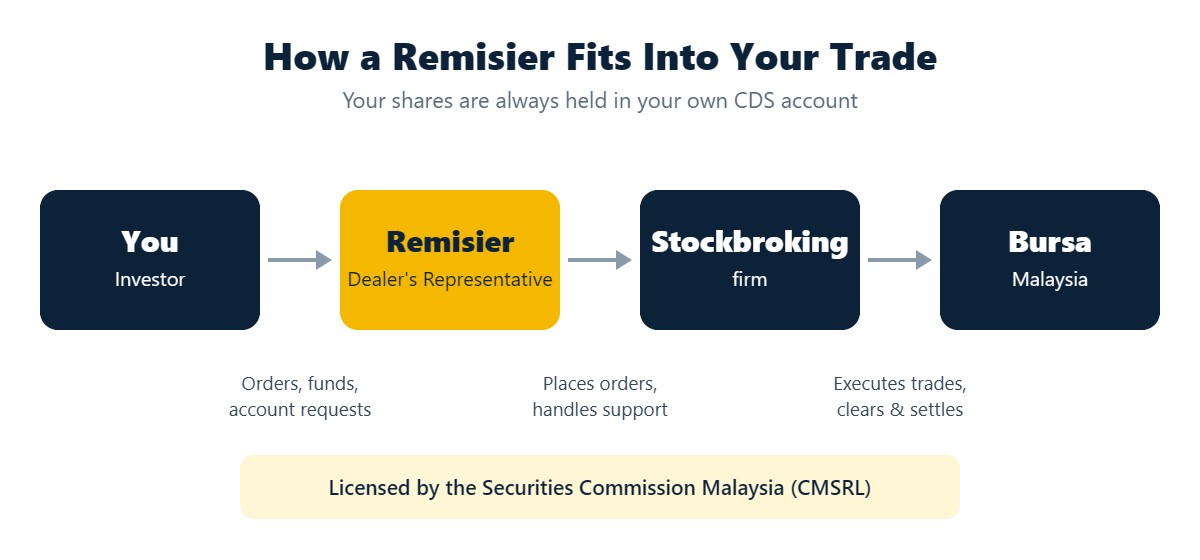
Quick answer: A remisier is a licensed, commission-based agent of a stockbroking firm in Malaysia who helps investors open trading accounts, place buy and sell orders, move funds, apply for IPOs and margin financing, and understand the market. The official title is Dealer’s Representative, and every remisier must hold a Capital Markets Services Representative’s Licence (CMSRL) from the Securities Commission Malaysia (SC). Unlike a salaried dealer, a remisier earns a share of the brokerage you pay and is personally liable if a client defaults.
If you have opened a CDS or trading account in Malaysia, there is a good chance a remisier is attached to it, even if you have never spoken to them. Many investors still aren’t sure what a remisier actually does, how they are paid, or whether they need one now that trading apps exist.
This guide explains it clearly, using how the Malaysian market works in 2026.
What Does “Remisier” Mean?
The word comes from French. A remisier was an intermediary who brought clients to a stockbroker and received a remise, a share of the commission, in return. Malaysia and Singapore kept the term, and in Malaysia it still describes the commission-based representatives of stockbroking firms.
In regulatory language, you won’t see the word “remisier” much. The Securities Commission and Bursa Malaysia call them Dealer’s Representatives. In everyday use, the two terms mean the same person.
What Does a Remisier Do?
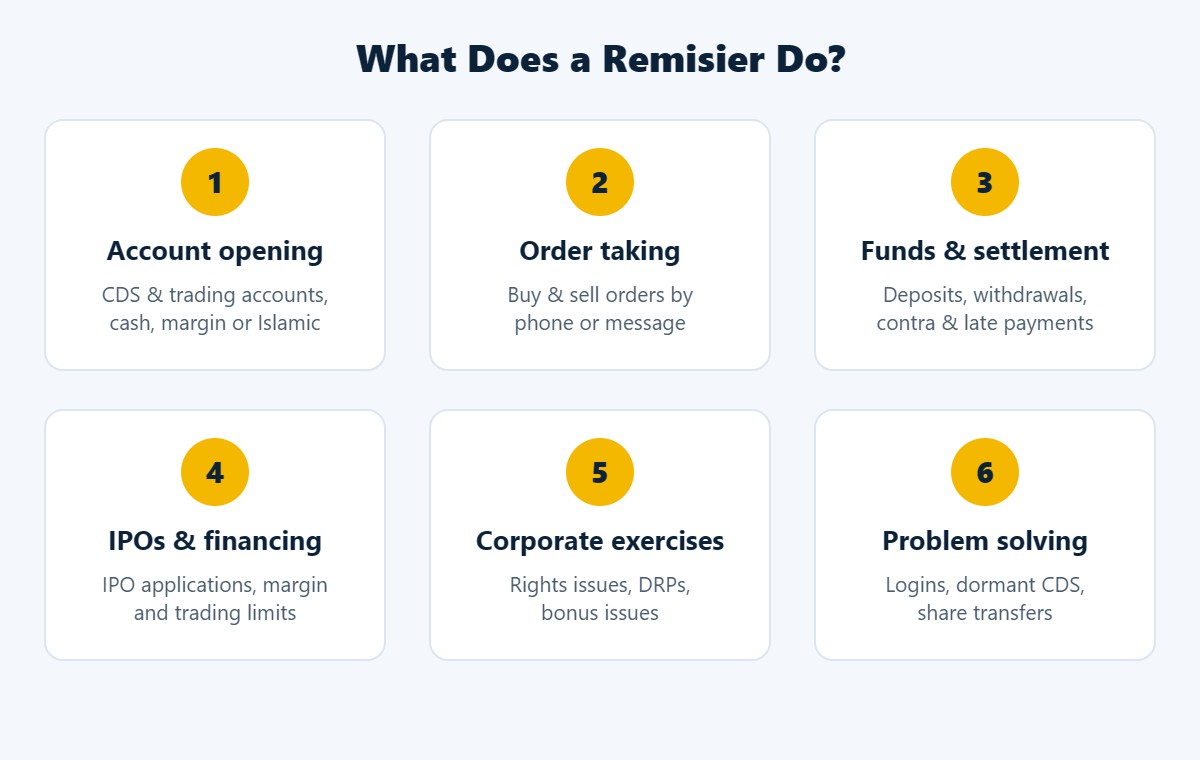
A good remisier is your main point of contact with your broker. Their day-to-day work usually includes:
- Account opening: guiding you through opening a CDS account and trading account, including conventional or Islamic accounts, cash or margin accounts, and foreign market access.
- Order taking: placing buy and sell orders for you by phone or message, which helps if you’re busy, travelling, or not comfortable with the trading app.
- Funds and settlement: helping with deposits, withdrawals, contra losses, and late payments, and chasing issues with the broker’s back office.
- Trading limits and financing: requesting higher trading limits, setting up margin financing, and helping with IPO financing applications.
- Corporate exercises: explaining rights issues, dividend reinvestment plans, bonus issues, and other corporate actions that need a decision from you.
- Market information: sharing research reports, market updates, and educational material, within what the rules allow.
- Problem solving: handling login and OTP issues, dormant CDS accounts, transfer of shares, and broker changes.
What a remisier should not do is trade your account without your instruction, guarantee returns, or pressure you to overtrade. Discretionary management of your money needs a different licence altogether.
How Does a Remisier Become Licensed?
To work as a remisier in Malaysia, a person generally needs to:
- Pass the SC licensing examinations relevant to dealing in securities.
- Be sponsored by a licensed stockbroking firm (a Participating Organisation of Bursa Malaysia) that applies for the licence on their behalf.
- Hold a Capital Markets Services Representative’s Licence (CMSRL) for dealing in securities under the Capital Markets and Services Act 2007, and be registered with Bursa Malaysia.
- Meet fit-and-proper requirements and continuing education each year to keep the licence active.
You can check any remisier’s licence yourself on the SC’s public register. We explain the steps in How to Check If Your Remisier Is Licensed (SC Register). If someone offering “stock tips” or account services isn’t on the register, don’t deal with them.
How Do Remisiers Get Paid?
Remisiers are not salaried employees. They earn a share of the brokerage commission that clients pay on trades. The split between the remisier and the broker is set by each firm and differs from broker to broker.
Two points are worth knowing as an investor:
- You don’t pay extra for having a remisier. Your brokerage rate depends on your account type and the channel you use (online or through the remisier), not on whether a remisier is assigned to you.
- Remisiers carry real risk. If a client fails to pay for shares bought or leaves a debit balance, the remisier is usually liable to the broker for that loss. That’s why remisiers care about trading limits and timely payment.
Remisier vs Dealer: What’s the Difference?
| Remisier (Dealer’s Representative) | Dealer | |
|---|---|---|
| Employment | Commission-based agent of the broker | Salaried employee of the broker |
| Income | Share of clients’ brokerage | Fixed salary plus bonus or incentives |
| Clients | Builds their own client base | Usually serves accounts assigned by the firm, or institutions |
| Liability for client losses | Usually personally liable | Generally borne by the firm |
| Licence | CMSRL from the SC | CMSRL from the SC |
For a deeper comparison, read Remisier vs Dealer in Malaysia: What’s the Difference & Why Appoint a Remisier.
Do You Still Need a Remisier in 2026?
Strictly speaking, you can trade on Bursa Malaysia entirely through a broker’s app. Many accounts opened online are still assigned to a remisier or a house dealer in the background.
Whether a remisier adds value depends on how you invest:
- You’ll benefit most if you apply for IPOs regularly, use margin or IPO financing, trade foreign markets, need quick help with deposits, withdrawals and account problems, or prefer to place orders by phone.
- You may need one less if you’re a self-directed, small-volume investor who is comfortable with the app and rarely needs support.
Even then, having someone who answers when your account is frozen, your OTP fails, or a corporate exercise deadline is close can save real money and stress.
How to Choose a Good Remisier
Look for a remisier who is licensed, responsive, transparent about fees, and focused on education rather than pushing trades. Ask how they communicate, what support they give for IPOs and financing, and which markets their broker offers. Our full checklist is in How to Choose a Remisier in Malaysia (2026): 7 Things to Check.
Can You Change Your Remisier?
Yes. You can ask your broker to reassign your trading account to another remisier at the same firm, or move to a different broker entirely by opening a new account and transferring your shares. Your shares stay in your CDS account throughout, so changing remisiers doesn’t mean selling anything.
Red Flags to Watch Out For
- Promises of guaranteed or “sure-win” returns.
- Asking you to transfer money to a personal bank account instead of the broker’s official client account.
- Trading in your account without your clear instruction.
- Asking for your login password or OTP.
- Not appearing on the SC public register.
Any of these is a reason to stop and contact the broker’s compliance team, or report it to the Securities Commission.
Frequently Asked Questions
Is a remisier the same as a stockbroker?
Not exactly. The stockbroker is the licensed firm (for example, an investment bank or stockbroking company). The remisier is an individual licensed representative who works with clients on behalf of that firm.
Is “remisier” the same as “Dealer’s Representative”?
Yes. “Dealer’s Representative” is the official regulatory title; “remisier” is the common term used in Malaysia.
Does every CDS account have a remisier?
Most trading accounts in Malaysia are tagged to a remisier or a house dealer code, even when opened online. You can ask your broker who is assigned to your account.
Do I pay more brokerage if I use a remisier?
Not just for having one. Rates depend on the broker, account type, and channel. Orders placed through a remisier by phone may carry a different rate from online orders, so check your broker’s fee schedule.
Can a remisier give stock recommendations?
A remisier can share their broker’s research and general market views, within the rules. The final decision is always yours, and a responsible remisier won’t pressure you or promise returns.
How do I check if a remisier is licensed?
Search their name on the Securities Commission Malaysia’s public register of licensed persons. See our step-by-step guide.
Key Takeaways
- A remisier is a licensed, commission-based Dealer’s Representative attached to a stockbroking firm.
- They help with accounts, orders, funds, IPOs, financing and corporate exercises.
- They’re paid from a share of brokerage and are usually liable for client defaults.
- Always verify a remisier on the SC public register before dealing with them.
- You can change your remisier at any time without selling your shares.
Related Guides
- How to Choose a Remisier in Malaysia (2026)
- How to Check If Your Remisier Is Licensed
- Remisier vs Dealer in Malaysia
- Conventional vs Islamic Trading Account
- Do You Pay Tax on Dividends in Malaysia?
- M+ Global Malaysia 2026: Fees, App and Getting Started
- Bahasa Melayu: Apa Itu Remisier? · Remisier vs Dealer: Apa Bezanya · Cara Memilih Remisier
This article is for general information only and is not investment advice.