This guide is for anyone holding a stock on Bursa Malaysia who wants to protect profits without having to watch the screen all day, or who wants to exit automatically if the trade turns against them.
What Is a Trailing Stop?
Imagine you bought a stock at RM2.50, and it rises to RM3.00. You want to protect your RM0.50 profit, but you also want to stay in the trade if it keeps climbing. A trailing stop does exactly that.
A trailing stop is a stop-sell order where the stop price (the trigger level) moves up with the market, but never moves down. You set a trail distance — say, RM0.10 or 5% — and the order automatically adjusts upward whenever the stock makes a new high. If the stock then falls back to your stop price, the order triggers and you sell.
The key phrase: the stop price follows the market up and locks in gains, but it never resets lower. That is what makes it different from a fixed stop-loss order.
Trailing Stop vs. Fixed Stop-Loss: What Is the Difference?
With a fixed stop-loss, you set one price and it stays there. If you buy at RM2.50 and set a stop at RM2.40, it remains at RM2.40 even if the stock hits RM3.50. You are using the same stop to protect against a loss and to exit on profit-taking — which is inefficient.
A trailing stop recalibrates after every new high. If your stock rises to RM3.00 with a RM0.10 trail, your stop is now RM2.90. If it then rises to RM3.20, your stop moves to RM3.10. You are chasing the upside, tightening your downside protection automatically.
| Feature | Fixed Stop-Loss | Trailing Stop |
|---|---|---|
| Stop price moves up? | No, stays fixed | Yes, follows market |
| Locks in profit? | Limits loss only | Yes, progressively |
| Useful for | Defined risk | Trending stocks |
Trailing Stop-Limit: Extra Control, Extra Risk
A trailing stop-limit order combines a trailing stop with a limit price. Instead of selling at the market when the stop is hit, you sell at or better than the limit price you set.
This sounds safer — you control the exit price — but it introduces a real risk: if the stock gaps down past your limit, your order will not fill. On Bursa Malaysia, especially with stocks that gap at opening, you could end up holding a loss when you meant to have exited.
For example: you own a stock at RM2.80 with a trailing stop-limit set RM0.15 below the current market (currently RM3.20). Your limit is RM3.05. The stock rises to RM3.30 overnight (or during the lunch break between sessions (12:30pm to 2:30pm)), then gaps down to RM2.90 at the next open. Your trailing stop, and its limit, move up to RM3.15. The market is at RM2.90, below your limit, so your sell order does not fill.
This is the trade-off: the limit protects you from slippage on normal exits, but it can trap you if the market gaps against you.
Worked Example: Stock Rising, Then Falling
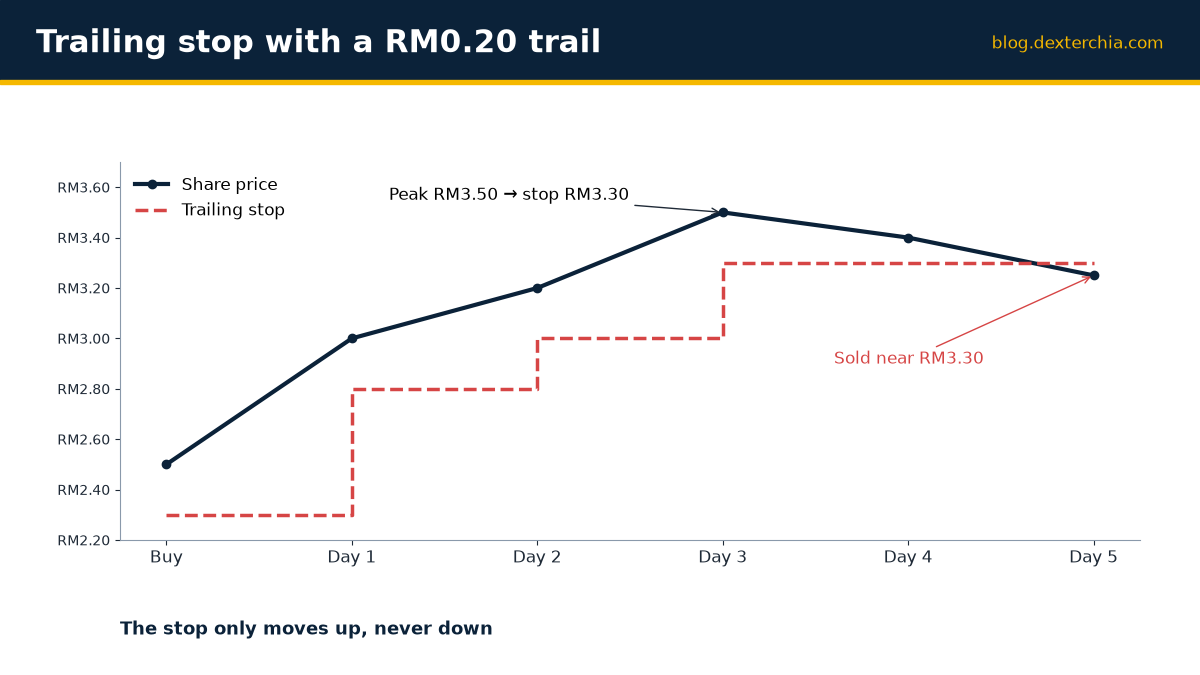
Scenario: You buy 500 shares at RM2.50. You set a trailing stop-sell with a trail distance of RM0.20.
- Day 1: Stock rises to RM3.00. Your stop is now RM2.80 (RM3.00 − RM0.20).
- Day 3: Stock peaks at RM3.50. Your stop moves to RM3.30 (RM3.50 − RM0.20). Your paper profit is now RM1.00 per share (RM500 on your 500 shares).
- Day 4: Stock falls to RM3.40. Your stop remains at RM3.30 — it does not move down.
- Day 5: Stock falls to RM3.25. Your stop is still RM3.30. Your trailing stop order triggers, and you sell at or near RM3.30.
- Final result: You exit with a profit of RM0.80 per share (RM400 on your 500 shares), locked in from the RM3.50 peak.
Without the trailing stop, you might have panicked and sold at RM3.25, or held too long hoping to recover to RM3.50. The trailing stop removed the emotion and the guesswork.
How to Choose Your Trail Distance
The trail distance is how far the stop lags behind the highest price reached. Bursa Malaysia tick sizes and volatility matter here.
For low-volatility or large-cap stocks: A tight trail (RM0.05 to RM0.10) works well. These stocks move predictably, and a close stop will not be whipsawed by everyday noise.
For mid-cap or growth stocks: A wider trail (RM0.20 to RM0.50) gives the stock breathing room. This reduces false triggers from intraday swings.
For micro-cap or penny stocks: Volatility is high, and Bursa’s tick size below RM1.00 is 0.5 sen. Use a trail of at least RM0.05 to RM0.10 to avoid whipsaw exits on tiny movements.
A rule of thumb: set your trail to roughly 1.5× to 2× the average intraday swing you observe over a week. If a stock bounces RM0.10 up and down most days, a RM0.15 trail avoids noise but still locks in gains.
M+ Global: Checking Your Options
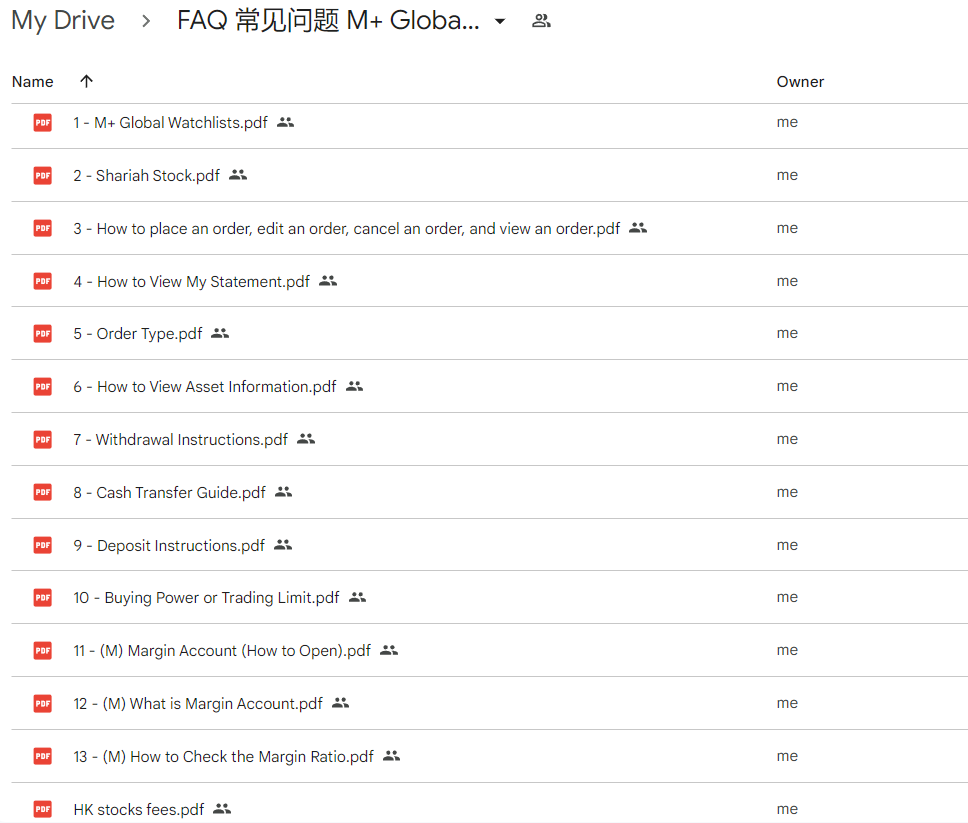
As of now, M+ Global’s documented order types for Malaysian stocks do not include trailing stops in the help centre. Your best bet is to check the order-type list in the M+ Global app directly, or contact your remisier to confirm what is available for Bursa Malaysia stocks.
If M+ Global does not offer native trailing stops for Bursa stocks, you have an alternative: use a fixed stop-loss order and adjust it manually as the stock rises. It is not automatic, but it works, and you keep full control.
For US and Hong Kong stocks traded through M+ Global, you can use conditional orders (launched 29 December 2023), which include Stop Loss and Stop Loss Limit orders. These are not trailing stops, but they do let you set a price trigger with a linked order, giving you some automation without having to watch the screen.
The Real Risks: Gaps, Whipsaws, and After-Hours Trading
Gap risk: Bursa Malaysia closes at 12:30pm and reopens at 2:30pm for the afternoon session. If news drops during the break and the stock gaps down at the open, your trailing stop may not trigger at a price near where it was set. You could be filled at a much lower price than expected.
Whipsaw risk: A volatile stock can jump up 2%, trigger a new trailing stop level, then drop 3%, hit your stop, and then recover 5% — all in one morning. You sold at the worst moment. This is why choosing a sensible trail distance is so important; a trail that is too tight will get whipsawed constantly.
No after-hours monitoring: Your trailing stop does not work outside Bursa’s trading hours. If the stock hits a new all-time high at 12:25pm (end of morning session), your stop recalibrates then. But during the 12:30pm to 2:30pm lunch break or overnight, the stock could fall sharply without your stop being able to react. When the market reopens, you are filled at whatever the market price is, not where you hoped.
Common Mistakes to Avoid
Setting the trail too tight: Beginners often use a RM0.05 trail on a RM3.00 stock and get whipsawed out repeatedly. Watch the stock for a few days to see how much it typically swings, then double that for your trail distance.
Forgetting about gaps: Do not assume your trailing stop will exit you at a predictable price. Plan for the possibility that Bursa opens at a gap to your stop level, and you get filled at whatever the open price is.
Leaving trailing stops active overnight on speculative stocks: If you own a micro-cap that is prone to news-driven gaps, be ready to cancel your trailing stop before close if something unusual happens. Trailing stops are best suited to relatively stable, liquid stocks.
Using a trailing stop-limit without understanding the limit risk: If you add a limit price to your trailing stop, make sure it is realistic. A limit that is too tight will never fill; one that is too loose defeats the purpose of having a limit.
Key Takeaways
- A trailing stop automatically moves your exit point upward as the stock rises, locking in profit without you having to do anything.
- The trail distance should match the stock’s volatility and Bursa’s tick size; too tight and you get whipsawed; too loose and you give back too much profit.
- A trailing stop-limit adds protection against slippage but risks leaving you unfilled if the stock gaps past your limit — a real hazard on Bursa.
- Check the M+ Global app to see what order types are available for Bursa Malaysia stocks, or ask your remisier.
- Gaps during Bursa’s breaks and overnight can fill your trailing stop at a very different price than expected — always plan for that possibility.
- Trailing stops work best on liquid, relatively stable stocks; avoid them on micro-caps and highly speculative names prone to sudden moves.
Frequently Asked Questions
Does M+ Global offer trailing stop orders for Bursa Malaysia stocks?
The order types documented in M+ Global’s help centre do not explicitly list trailing stops for Bursa stocks. Check the order-type list in your M+ Global app, or WhatsApp me to confirm what is currently available for your account.
What happens if my trailing stop-limit order does not fill?
If the stock gaps down below your limit price, the sell order will not execute, and you will stay in the position. This is the main risk of adding a limit to a trailing stop; you get precision but lose the certainty of exit. If this happens, you can cancel the order and place a new market order, or adjust the limit and wait for the next opportunity.
Can I use a trailing stop on a short sale?
Yes, but it works in reverse. A trailing stop on a short would move downward as the stock falls, letting you lock in gains. However, confirm with your remisier whether Bursa Malaysia regulations and your account permissions allow short selling, as this is not available to all retail traders.
How often does the trailing stop recalculate?
It recalculates with every new high (or low, on a short). If your stock touches RM3.50, your stop moves instantly. If it then touches RM3.51, your stop moves again. This happens throughout the trading day whenever a new extreme is reached.
What if I am away or my phone loses internet — will my trailing stop still work?
Yes. Once you place a trailing stop order, it lives on Bursa Malaysia’s trading system, not on your phone. Even if you lose internet, the order continues to monitor the stock and will execute if the stop is hit. You only need internet to place the order; the exchange handles the rest.
If you are ready to start using stop orders on M+ Global, or you want to discuss whether a trailing stop is right for your holdings, reach out anytime. I am here to help you set it up the right way. WhatsApp me at +60169059789, or get started with M+ Global using my invitation code UBZQ.
Dexter Chia
Remisier, Malacca Securities Sdn Bhd
Need Help With This?
If you are an M+ Global client and need help with this process, message me directly — I handle these requests for clients every week.
WhatsApp: +60169059789 | M+ Global Invitation Code: UBZQ
Disclaimer: This article is for informational purposes only and does not constitute financial advice. Always do your own research before making investment decisions.
Want to invest in Bursa Malaysia or US markets? Contact Dexter Chia, an AI Driven Remisier who has 2,200+ clients at Malacca Securities Sdn Bhd (M+ Global). M+ Global Invitation Code: UBZQ | WhatsApp: +60169059789 | Why Choose Dexter?