If you hold stocks on Bursa Malaysia and want to protect yourself from big losses—or lock in profits on US and Hong Kong stocks through M+ Global—you need to understand the difference between these two tools. I use them every day with my clients, and picking the wrong one can cost you thousands of Ringgit.
What Is a Stop-Market Order?
A stop-market order (often just called a ‘stop order’) sits dormant until the price of your stock hits a specific trigger price you set. Once that price is reached, your order automatically converts into a market order and executes immediately at the best available price in the market at that moment.
Think of it as a trip wire. The wire does nothing until someone crosses it, then the alarm goes off.
The key promise of a stop-market order is execution certainty. Once triggered, you will get out. The price you receive, however, may be worse than you expected—especially if the stock gaps down or volume dries up when your trigger hits.
What Is a Stop-Limit Order?
A stop-limit order is two orders in one. It sits dormant until your trigger price is hit, but instead of becoming a market order, it becomes a limit order at a price you specify in advance.
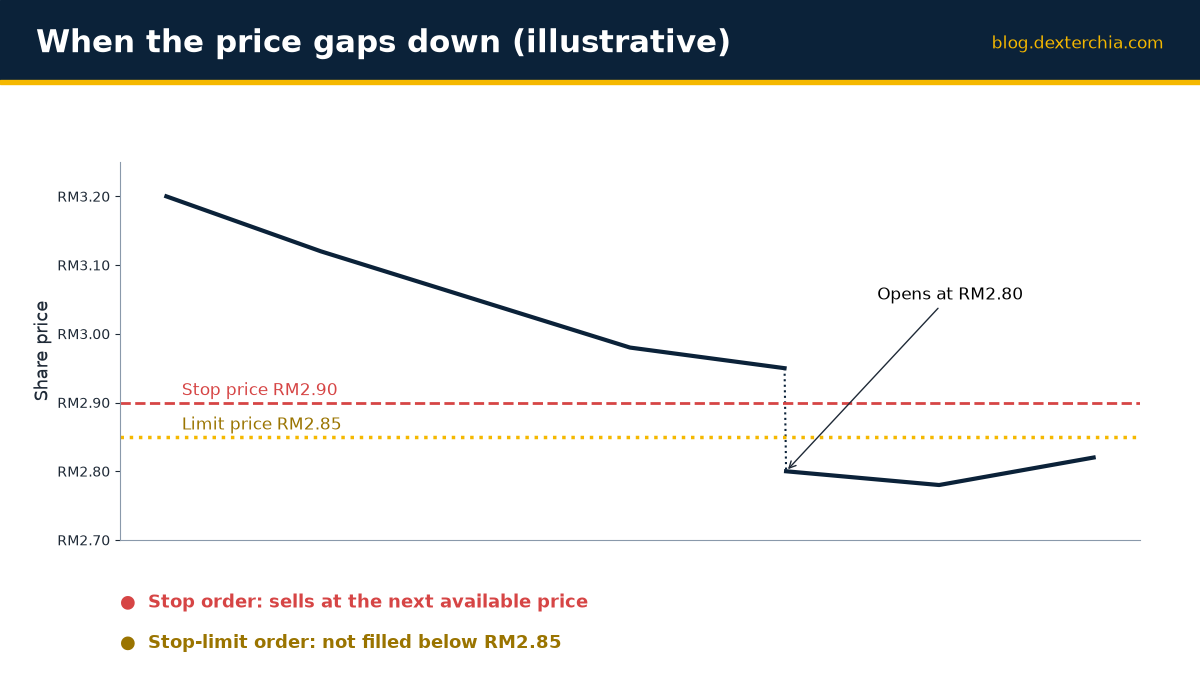
Once triggered, your order enters the market as a limit order. It will only execute if the stock trades at or better than your limit price. If the price moves away from your limit, your order sits unmatched.
Stop-limit gives you price certainty. You know the worst price you’ll receive. But there is no guarantee you will execute at all.
Worked Example: Protecting a Stock Position
Let’s say you bought 1,000 shares of a Bursa-listed stock at RM2.80 per share. The stock is now trading at RM3.20. You want to protect your profit, but you don’t want to sell just yet.
Your stop-market order: You set a trigger price of RM2.90 (about 9% below current price). If the stock drops to RM2.90, your stop-market order triggers and converts to a market order. It executes immediately. You might get RM2.89, or RM2.87, or even RM2.85 depending on how fast the stock is falling and how much volume is available. You are guaranteed out, but the exit price is uncertain.
Your stop-limit order: You set a trigger price of RM2.90 and a limit price of RM2.88. When the stock hits RM2.90, your order becomes a limit order to sell at RM2.88 or better. If the stock bounces back to RM2.95 before dropping further, your order never executes—the stock never reached RM2.88. But if it does fall through RM2.88, you will sell at RM2.88 or better.
The gap scenario: This is where the difference bites. Suppose the company announces bad news overnight, and the stock opens the next morning at RM2.60 instead of RM2.90. Your stop-market order will trigger during the opening and execute, likely at or near RM2.60 (a bigger loss than you planned). Your stop-limit order with a trigger of RM2.90 and limit of RM2.88 will also trigger, but it will not execute at RM2.60 because that is below your limit. You remain holding the stock at a loss of RM2.60 per share, unexecuted and exposed.
How Bursa Malaysia Handles Stop Orders
Bursa Malaysia’s trading system accepts both stop-market and stop-limit orders. Here is the critical part: Bursa checks stop orders against price limits only when they are triggered.
This means your stop order can sit in the market without violating Bursa’s static price limits (which prevent orders priced too far from the reference price). But once triggered, if your limit price falls outside the day’s limits, it will be rejected.
In practice, this rarely affects retail traders, but it is worth knowing. If you set a stop-limit order with an unusually wide gap between trigger and limit price, and the market moves sharply, your limit price might fall outside Bursa’s daily limits when it triggers and be rejected.
Stop Loss and Stop Loss Limit on M+ Global
If you trade US or Hong Kong stocks through M+ Global, you have access to conditional orders launched on 29 December 2023. The equivalents of stop-market and stop-limit are called Stop Loss and Stop Loss Limit.
On M+ Global, you set a trigger direction (price falls to), a trigger price, and then either a market order (Stop Loss) or a limit order with your chosen limit price (Stop Loss Limit). You can set validity as Day or Good till Cancelled, and for US stocks you can choose regular or extended hours.
For a full walkthrough of how to place these orders in M+ Global, see my conditional orders guide here.
Comparison Table: Stop-Market vs Stop-Limit
| Aspect | Stop-Market Order | Stop-Limit Order |
|---|---|---|
| What it becomes | Market order | Limit order |
| Execution guarantee | Yes—you will exit | No—may not fill |
| Price guarantee | No—price can slip | Yes—at limit or better |
| Best used for | Getting out quickly if stock crashes | Protecting a price level while staying flexible |
| Gap risk | You execute at much worse price | You may not execute at all |
Common Mistakes to Avoid
Setting a stop too close. If you buy at RM2.80 and set a stop-market trigger at RM2.75 (2%), normal daily volatility might trigger it on a regular pullback. Use a trigger price that reflects real support levels, not just round numbers.
Forgetting that stop-limit orders can go unfilled. Many clients set a stop-limit, expect it to execute as a safety net, then are shocked to find they still held the stock when it fell further. Stop-limit protects your exit price, not your position.
Setting a limit price too far below the trigger. If your trigger is RM2.90 but your limit is RM2.70, a fast gap down will skip over your limit and leave you unexecuted. Keep them close together unless you have a specific reason not to.
Using stop orders to time the market. Stop orders are for protection, not for catching bottoms or riding reversals. If you are holding because you believe in the company, use a wider stop. If the stop gets hit, you were wrong about your entry.
Key Takeaways
- A stop-market order guarantees execution but not price; a stop-limit order guarantees price but not execution.
- Once triggered, a stop order checks against Bursa’s daily price limits; an unfilled stop-limit can be rejected if its limit price falls outside those limits.
- In a gap-down scenario, stop-market executes at a worse price, while stop-limit may not execute at all.
- On M+ Global (US and HK stocks), use Stop Loss for certainty of exit and Stop Loss Limit for certainty of price.
- Set your trigger price at a real support level, not a round number, to avoid being knocked out by normal volatility.
- Choose your order type based on what matters more: getting out, or getting out at a specific price.
Frequently Asked Questions
Can I cancel a stop order once it has been triggered?
No. Once your stop order is triggered and converts into a live market or limit order, you cannot cancel it during that conversion. You can cancel the resulting limit order only if it remains unmatched, but a market order executes instantly and cannot be cancelled.
Will my stop order remain active if the stock gaps below my trigger price?
Yes, your stop order will trigger during the opening auction or as soon as the stock trades at or below your trigger price, regardless of how fast it fell. However, the actual execution price may be much worse than your trigger if the stock has gapped down significantly.
What happens to my stop order at the end of the trading day?
You would need to re-enter them the next day. Check with your remisier about whether you can set them as good-till-cancelled if you want them to persist beyond one day.
Are stop orders cheaper than regular limit orders?
No. Stop orders incur the same brokerage, clearing fees, and stamp duty as any other order once they execute. The fees are charged on the execution price and trade value, not the trigger price.
Can I use a stop-limit order to catch a bounce if the stock falls?
No. Stop orders are for closing or protecting a position, not for entering on a bounce. If the stock falls to your trigger but then bounces above your limit price, your order never executes and you remain on the sidelines. For entry strategies, use a regular limit order or speak with your remisier about other order types.
The difference between these two order types has saved many of my clients from larger losses, and cost others dearly because they chose the wrong one. If you are uncertain which suits your situation, do not guess. Reach out to me on WhatsApp at +60169059789, and we can work through your strategy together. You can also sign up for M+ Global using my invitation code UBZQ if you are not already a client.
Need Help With This?
If you are an M+ Global client and need help with this process, message me directly — I handle these requests for clients every week.
WhatsApp: +60169059789 | M+ Global Invitation Code: UBZQ
Disclaimer: This article is for informational purposes only and does not constitute financial advice. Always do your own research before making investment decisions.
Want to invest in Bursa Malaysia or US markets? Contact Dexter Chia, an AI Driven Remisier who has 2,200+ clients at Malacca Securities Sdn Bhd (M+ Global). M+ Global Invitation Code: UBZQ | WhatsApp: +60169059789 | Why Choose Dexter?