Baca dalam Bahasa Malaysia · 阅读中文版
When you open a trading account in Malaysia, the broker will ask which account type you want. The choice decides how much you can buy, when you must pay and how much risk you take. Here is how each one works.
How does Bursa settlement (T+2) work?
Every Bursa Malaysia trade settles on T+2: two market days after the trade date (weekends and public holidays are not counted). If you buy on Monday, payment is due and the shares reach your CDS account on Wednesday. The account types below differ in whether you must have the cash before you buy, or only by T+2.
1. What is a cash upfront account?
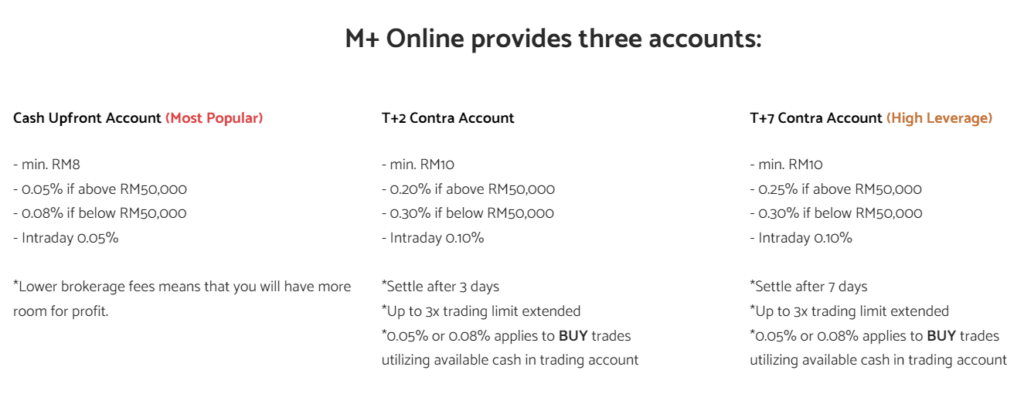
A cash upfront account works like a debit card. You deposit cash first, usually by FPX online banking, and can only buy up to that amount.
- Pros: no risk of owing the broker money, simple to manage, and brokerage rates are often the lowest.
- Cons: no leverage; you cannot buy more than you have deposited.
- Best for: beginners, long-term investors and anyone who wants to keep risk under control.
2. What is a contra account?
A contra account (sometimes called a cash or collateral account) works more like a charge card. The broker gives you a trading limit based on the cash and shares you hold with it as collateral. Limits vary by broker and by stock; Rakuten Trade, for example, publishes up to 5 times collateral for Main Market stocks and up to 3 times for ACE Market stocks.
After buying, you have until T+2 to either:
- Pay in full and keep the shares, or
- Sell before settlement (“contra”). You then settle only the difference: a contra gain is paid to you, and a contra loss must be paid by the due date.
Some brokers offer a longer payment period on selected accounts. Ask your remisier what applies to yours before relying on it.
The risk: if the price falls and you do not pay the loss or the full amount on time, the broker can force-sell your shares, charge late interest and freeze further buying. Leverage magnifies losses as much as gains.
- Best for: experienced short-term traders who watch their positions daily and keep enough cash to cover losses.
3. What is a margin account?
A margin account is a share-financing facility. The broker (or a financier it works with) lends you money to buy shares and you pay interest on the amount borrowed, for as long as you hold the position. It lets you hold leveraged positions beyond T+2.
- Margin call: if your shares fall and your equity drops below the required level, you must top up cash or collateral, or the financier sells shares to reduce the loan.
- Cost: interest rates vary. On M+ Global, US and Hong Kong margin is quoted at 8% a year; Bursa margin facilities are arranged separately.
- Best for: experienced investors who understand interest costs and forced-selling risk.
Which account should you choose?
| Cash upfront | Contra | Margin | |
|---|---|---|---|
| Pay before buying? | Yes | No, by T+2 | Partly (loan covers the rest) |
| Leverage | None | Short-term, up to broker limit | Longer-term loan |
| Interest | None | Only on late payment | Yes, on the loan |
| Main risk | Market risk only | Contra losses, force selling | Margin calls, force selling |
| Suits | Beginners, long-term investors | Active short-term traders | Experienced leveraged investors |
Many investors start with cash upfront and apply for a contra or margin facility later, once they have a track record with the broker.
Is an Islamic trading account different?
Islamic accounts follow Shariah principles: no interest-based financing, and you trade Shariah-compliant securities. If this matters to you, ask your broker whether it offers an Islamic account and how its rules differ. See Shariah-compliant investing with M+ Global.
Frequently asked questions
Why is my trading limit different from my cash balance?
On a contra or margin account, your limit includes the value the broker assigns to your collateral, so it can be higher than your cash. On cash upfront, the limit equals your available cash.
Can I change my account type later?
Usually yes. Contra and margin facilities need a separate application and approval. Ask your remisier.
How do I open an account?
See How to Open a CDS and Trading Account in Malaysia (2026) and, for a beginner overview, How to Own Shares in Malaysia.
Key Takeaways
- Bursa trades settle on T+2.
- Cash upfront: buy only with deposited cash; lowest risk.
- Contra: trading limit on your collateral; pay or sell by T+2 and cover any contra loss on time.
- Margin: borrowed money with interest; watch for margin calls.
- Start with cash upfront unless you understand leverage.
If you would like to open an M+ Global account with Malacca Securities, you can use invitation code UBZQ.
Disclosure: Dexter Chia is a licensed dealer’s representative (DR code R336) at Malacca Securities Sdn Bhd. This guide is for education only and is not investment advice. Trading limits, rates and facilities differ by broker and change over time; check your broker’s terms.