Trump’s tariffs were supposed to push US prices higher. The Liberation Day tariffs, first unveiled in April 2025, ranged from a minimum 10% to as high as 50%. The Yale Budget Lab had estimated a 2.3% rise in US prices in the short run.
Why Did Trump’s Tariffs Fail to Lift US Inflation?
Headline CPI and core CPI, which excludes energy and food, edged higher in the months after the tariffs took effect. Both measures peaked at 3% to 3.1% in 3Q2025, then trended lower.
Inflation accelerated again this year, but the source attributes it to higher energy prices from the US-Iran war. Prices of tariff-affected goods have slowed meaningfully or fallen outright in recent months.
How Much of Trump’s Tariff Cost Did Foreign Exporters Absorb?
The Optimal Tariff Theory says a country with market power can shift part of its tariff cost onto foreign exporters. WTO estimates show the US trade-weighted average tariff rose from 2.4% before Trump took office to 21.9% in early May, then fell to just over 13% by end-2025.
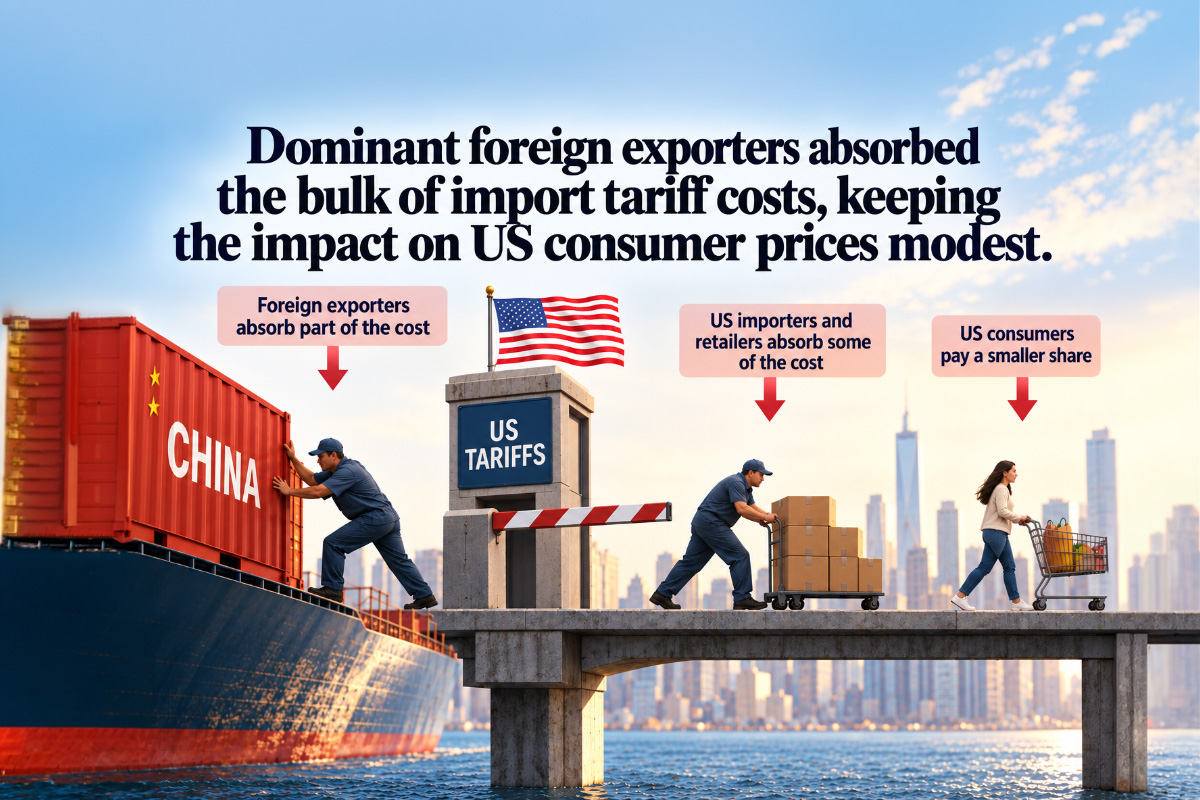
A Centre for Economic Policy Research (CEPR) study of the 50 largest US trading partners found foreign exporters absorbed roughly 40% to 50% of the 2025 tariff increases through lower export prices. Dominant suppliers bore the bulk, while smaller ones passed the tariff on almost fully.
Why Did Chinese Toy Exporters Cut Prices by 22%?
Chinese exporters of toys and dolls saw US tariffs rise 28% while cutting export prices by 22%. That absorbed roughly 80% of the shock, so US importers paid only a small portion of the burden.
- China accounts for one-fifth of global manufactured-goods exports.
- Nearly one-third of China’s larger industrial enterprises operate at a loss.
- China’s merchandise trade surplus surged nearly 20%, from US$992 billion in 2024 to a record US$1.2 trillion in 2025.
How Did the Malaysian Portfolio Perform Against the FBM KLCI?
The Malaysian Portfolio fell 1.4% in the week ended Oct 7, against a 2.4% drop in the FBM KLCI. Every stock in the portfolio closed in the red, which makes the individual losers worth monitoring.
- OCK Group: -5.2%
- Public Bank: -2.3%
- Hong Leong Industries: -1.5%
Total portfolio returns dropped to 208.9% since inception. The benchmark index is down 11.9% over the same period.
What Moved the Absolute Returns and AI Portfolios?
The Absolute Returns Portfolio gained 0.9% for the week, lifting total returns to 34.9% since inception. Talen Energy Corp (+21.0%), Nvidia Corp (+4.0%) and Microsoft Corp (+3.3%) led the gainers, while Schneider Electric fell 14.0%.
The AI Portfolio rose 2.2%, taking total returns to 34.5%. Hewlett Packard Enterprise (+12.8%), Cadence Design Systems (+7.9%) and Marvell Technology (+7.7%) led, while Unusual Machines dropped 10.6%. Readers tracking AI-linked names can review our AI Stock Analysis for Malaysians guide.
Key Takeaways
- The predicted US inflation surge from tariffs did not materialise; energy prices drove the 2026 uptick.
- Exporters, not US consumers, carried much of the tariff burden.
- Chinese manufacturers’ domestic price wars push them to export at higher margins.
- The Malaysian Portfolio outperformed the FBM KLCI in the week ended Oct 7, though every holding closed lower.
Disclaimer: This article is for general information only and does not constitute investment advice. Always do your own research before making any investment decision.
Frequently Asked Questions
Did Trump’s tariffs cause US inflation to rise?
Only briefly. US CPI and core CPI peaked at 3% to 3.1% in 3Q2025 and then trended lower, while the 2026 rise was linked to higher energy prices from the US-Iran war.
How much of Trump’s tariff cost did foreign exporters absorb?
CEPR estimates foreign exporters absorbed roughly 40% to 50% of the 2025 US tariff increases through lower export prices. Dominant suppliers bore the bulk, while smaller ones passed the tariff on almost fully.
How did the Malaysian Portfolio perform against the FBM KLCI?
The Malaysian Portfolio fell 1.4% for the week ended Oct 7, versus a 2.4% drop in the FBM KLCI. Public Bank, OCK Group and Hong Leong Industries were among the biggest losers.
Source: View Original Article — The content is based on the original publisher. Refer to the original content for accurate info. Contact us for any changes.
Related Articles & Resources
Disclaimer: This article is for informational purposes only and does not constitute financial advice. Always do your own research before making investment decisions.
Want to invest in Bursa Malaysia or US markets? Contact Dexter Chia, an AI Driven Remisier who has 2,200+ clients at Malacca Securities Sdn Bhd (M+ Global). M+ Global Invitation Code: UBZQ | WhatsApp: +60169059789 | Why Choose Dexter?