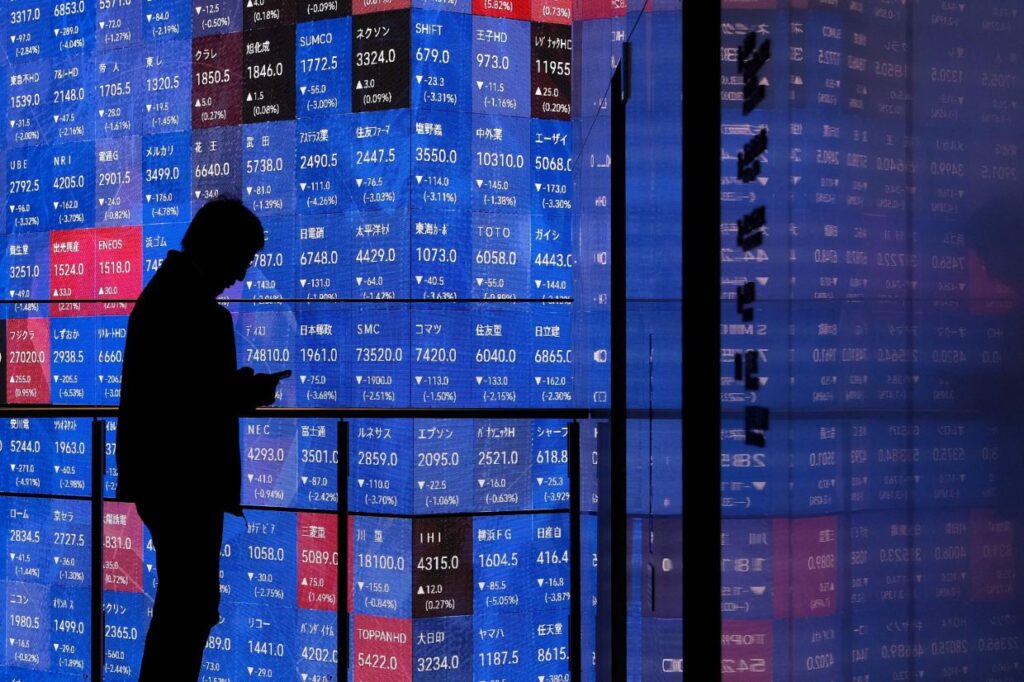
Nikkei AI stocks led Japan’s market lower on Wednesday. The Nikkei average slumped 3.1%, while the broader Topix fell 1.85% to 3,857.97.
Why Did Nikkei AI Stocks Slide on Wednesday?

Investors sold AI-linked stocks on concerns that Democratic gains in the US midterm elections could lead to stricter rules for data-centre projects. The same concern could slow AI infrastructure spending.
Takamasa Ikeda, senior portfolio manager at GCI Asset Management, said: “Democrats are winning seats in some key states. That fuelled caution for stricter regulations on AI infrastructure investment.”
Which Japanese AI Stocks Fell the Most?
The sell-off hit chip, memory and fibre-optic names hardest. Investors may want to watch these moves closely:
- Kioxia (memory chip maker): down 10%
- Furukawa Electric (fibre-optic cables): down 9%
- Fujikura (fibre-optic cables): down 8.2%
- SoftBank Group (technology investor): down roughly 7%
- Advantest (chip-testing equipment): down 6.4%
- Tokyo Electron (chip equipment): down 5%
Fibre-optic cable makers are key materials for data centres. Their drop shows the sell-off reached beyond chipmakers.
How Broad Was the Nikkei Sell-Off?
Of the 225 components in the Nikkei, 130 fell while 95 rose. The breadth of the decline points to a sector-wide reaction rather than a few isolated stocks.
What Else Is at Stake in the US Midterms?
The US election result could affect several market-sensitive areas. These include the AI data-centre buildout, the US fiscal outlook, defence spending and regulation in healthcare, banking and cryptocurrencies.
Prediction markets signalled growing expectations of a Democratic sweep of the US Congress. More than $1.48 billion was wagered on the midterm elections.
Does This Affect Bursa Malaysia Stocks?
The source does not name any Bursa Malaysia-listed company, so no Bursa stock code or RM figure can be tied to this move. Malaysian holders of AI-linked names should check their own exposure to US and Japanese data-centre supply chains.
Key Takeaways
- The Nikkei fell 3.1% to 61,127.9, while the Topix dropped 1.85% to 3,857.97.
- Concerns over stricter US rules for data-centre projects drove the selloff in AI-linked stocks.
- Kioxia (down 10%) and Furukawa Electric (down 9%) recorded the steepest falls among the names cited.
- 130 of the 225 Nikkei components fell, while 95 rose.
- More than $1.48 billion was wagered on the US midterm elections.
Disclaimer: This article is for general information only and does not constitute financial advice, a buy or sell recommendation, or a price forecast. Figures are taken from a Reuters report on Japanese markets. Always do your own research before making any investment decision, and consider reading our AI Stock Analysis for Malaysians guide.
Frequently Asked Questions
How much did the Nikkei fall on Wednesday?
The Nikkei fell 3.1% to 61,127.9 by 0150 GMT on Wednesday. The broader Topix dropped 1.85% to 3,857.97 in the same session.
Why did Japanese AI stocks drop after the US midterms?
Investors feared that Democratic gains could lead to stricter rules for data-centre projects and slow AI infrastructure spending. Takamasa Ikeda of GCI Asset Management said the result fuelled caution on AI infrastructure investment.
Which Japanese AI stocks fell the most?
Kioxia fell 10% and Furukawa Electric dropped 9%. Fujikura fell 8.2%, SoftBank Group slipped roughly 7%, and Advantest declined 6.4%.
Does the Nikkei sell-off affect Bursa Malaysia stocks?
The source does not name any Bursa Malaysia-listed company, so it cannot confirm a direct impact. Investors may want to check whether their holdings have exposure to AI data-centre supply chains.
Source: View Original Article — The content is based on the original publisher. Refer to the original content for accurate info. Contact us for any changes.
Related Articles & Resources
Disclaimer: This article is for informational purposes only and does not constitute financial advice. Always do your own research before making investment decisions.
Want to invest in Bursa Malaysia or US markets? Contact Dexter Chia, an AI Driven Remisier who has 2,300+ clients at Malacca Securities Sdn Bhd (M+ Global). M+ Global Invitation Code: UBZQ | WhatsApp: +60169059789 | Why Choose Dexter?