This is one of the first things a new investor gets wrong, and it costs real money on Malaysian small caps. Here is what each order type actually does, and when to use which.
What Each Order Type Actually Does
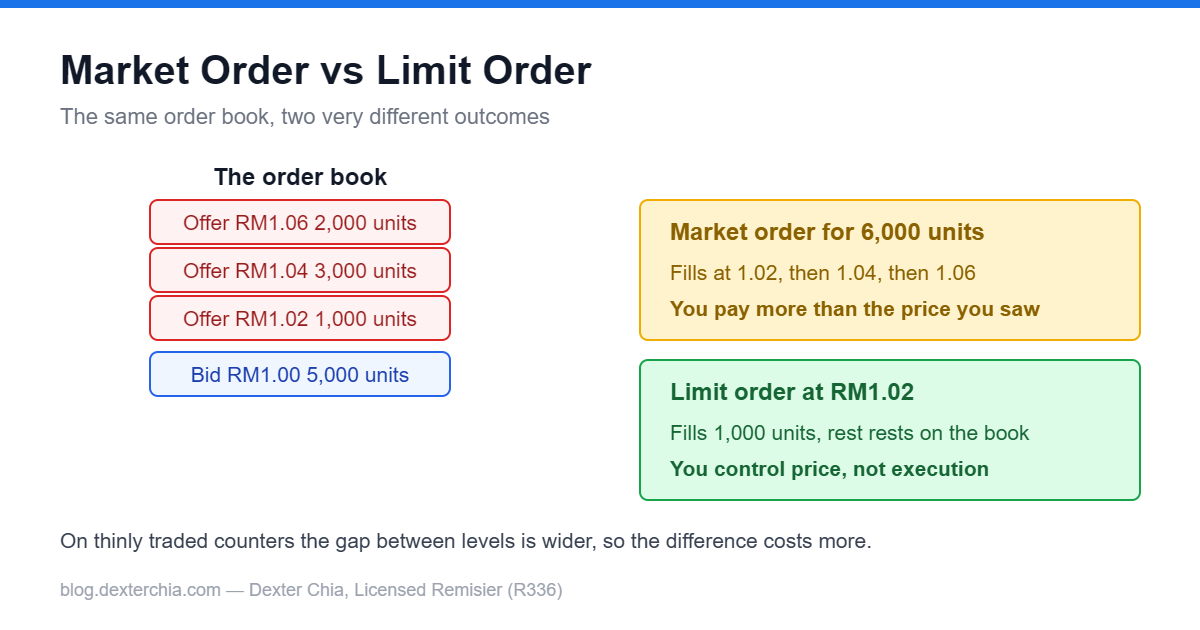
A market order says: fill me now, at whatever the best available price is. You are guaranteeing execution but not price.
A limit order says: fill me only at this price or better. You are guaranteeing price but not execution. If nobody meets your price, nothing happens.
Everything else follows from that trade-off. You cannot have both.
Why the Order Book Matters More Than the Last Price
The price quoted on your screen is the last done price. It tells you what somebody else paid, historically. It does not tell you what you will pay.
What you will pay comes from the order book, specifically the best offer sitting there waiting. On an active counter, the gap between the best bid and the best offer is narrow, often a single tick. On a quiet counter, that gap can be wide.
So a market order on a quiet stock reaches up and takes whatever is on offer, which may be several ticks above the last done price you were looking at.
Where Market Orders Hurt on Bursa
Malaysia has a large number of thinly traded counters, and this is where the damage happens.
Thin order books: If only a small volume sits at the best offer and you order more than that, the remainder fills at progressively worse prices up the book.
Wide spreads: On an illiquid counter the spread itself can be a meaningful percentage of the price. Crossing it twice, buying and later selling, is a real cost before the stock has moved at all.
Volatile opens: Prices immediately after the market opens can move sharply as overnight orders clear. A market order placed into that is a lottery.
None of this is theoretical. On a counter trading a few hundred thousand ringgit a day, a careless market order can cost you several percent instantly.
When a Market Order Is the Right Call
Market orders are not always wrong. They make sense when execution genuinely matters more than a tick or two.
Liquid blue chips: On heavily traded index counters, the spread is narrow and depth is good. The cost of crossing is negligible.
You need out now: If you have decided to exit on news and the position is meaningful, insisting on a limit price can leave you holding something you wanted to be rid of.
Outside those cases, a limit order costs you nothing but patience.
How to Set a Sensible Limit Price
The common mistake is setting a limit so far from the market that it never fills, then feeling clever about the discipline while the stock runs away.
A more practical approach is to look at the current best bid and offer, then place your limit at or just inside the spread. You are asking for a slightly better price than a market order would give you, without demanding a price nobody is offering.
Also size your order against what is actually available. If the book shows thin volume at your price, expect a partial fill rather than assuming the whole order goes through.
Costs Apply Either Way
Whichever order type you use, brokerage and the associated fees apply on both the buy and the sell. On small orders those fixed costs matter more in percentage terms than the tick you saved. Your client statement shows exactly what each trade cost you, and it is worth checking rather than estimating.
Key Takeaways
- Market orders guarantee execution, not price. Limit orders guarantee price, not execution.
- The last done price is history. The order book determines what you actually pay.
- On thinly traded Bursa counters, market orders can fill well away from the quoted price.
- Market orders are reasonable on liquid blue chips or when you genuinely need to exit immediately.
- Set limits at or just inside the spread rather than at a price nobody is offering.
- Check the depth available before sizing an order, or expect partial fills.
If you are not sure how a particular counter’s order book looks before you trade it, ask me. I’m Dexter Chia, remisier at Malacca Securities Sdn Bhd, on WhatsApp at +60169059789 or via M+ Global invitation code UBZQ.
Need Help With This?
If you are an M+ Online or M+ Global client and want to talk this through for your own account, message me directly — I handle these questions for clients every week.
WhatsApp: +60169059789 | M+ Global Invitation Code: UBZQ
Disclaimer: This article is for informational purposes only and does not constitute financial advice. Always do your own research before making investment decisions.
Want to invest in Bursa Malaysia or US markets? Contact Dexter Chia, an AI Driven Remisier who has 2,200+ clients at Malacca Securities Sdn Bhd (M+ Online / M+ Global). M+ Global Invitation Code: UBZQ | WhatsApp: +60169059789 | Why Choose Dexter?