This comes up in almost every conversation with a client who has just received a bonus, an inheritance, or an EPF withdrawal. They have a lump of cash and a list of Bursa counters they want to own. Should they buy everything now, or spread it out?
The maths and the psychology point in opposite directions. Which one should win depends on something specific about you.
What the Maths Says: Lump Sum Usually Wins
Markets rise more often than they fall. Over any long stretch, money sitting in cash waiting to be deployed is money earning nothing.
So if you hold back two thirds of your capital for six months, you have guaranteed that two thirds of your money misses whatever the market does in that time. Most of the time, that costs you.
The evidence is consistent: studies across multiple markets find lump sum investing beats dollar cost averaging more often than not, usually by a modest margin.
On pure expected return, buying now wins. That is not the whole story though.
What the Psychology Says: DCA Protects You From Yourself
The lump sum argument assumes you behave identically in both scenarios. In practice, investors do not.
Picture someone who puts RM200,000 into Bursa counters in a single morning, then watches the index drop 12% over two months. The correct response is to do nothing. The common response is to sell near the bottom, sit in cash while the market recovers, and re-enter higher. That turns a temporary paper loss into a permanent one.
What DCA actually does: it is not return optimisation, it is regret management. Spreading entries means no single purchase price becomes the number you torture yourself with.
A theoretically optimal plan you abandon is worse than a decent plan you follow.
The Bursa Wrinkle: Costs Punish Small Frequent Orders
This is where general international advice needs adjusting for the local market.
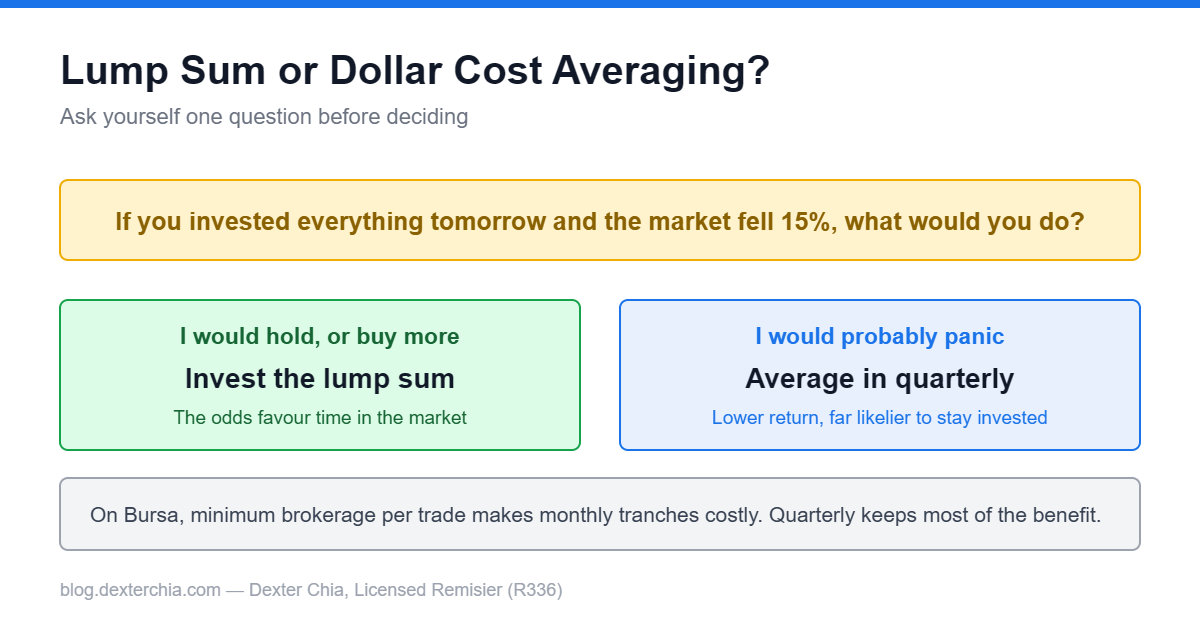
Minimum brokerage: Malaysian brokerage typically carries a minimum charge per trade. Buying RM500 of a counter monthly pays that minimum twelve times a year on tiny orders. Buying RM6,000 once pays it once.
Board lots: Bursa trades in lots of 100 shares. On a counter priced at RM12, one lot costs RM1,200, so a monthly budget below that cannot buy a lot at all. Odd lots are far less liquid and often price poorly.
The consequence is that monthly DCA on individual Bursa counters only makes sense above a certain order size. Below it, fee drag eats more than the volatility protection is worth. Your client statement shows exactly what each trade costs you.
How to Do This Well
Use quarterly tranches, not monthly. Four larger orders instead of twelve small ones cuts your minimum-brokerage exposure while keeping most of the averaging benefit.
Check your own brokerage rate first. Work out what percentage of a typical order the minimum represents. Above roughly half a percent, your tranches are too small.
Set the schedule in advance and follow it. The benefit disappears if you second-guess each tranche based on how the market looks that week. At that point you are market timing with extra steps.
Consider a hybrid. Deploying half immediately and averaging the rest over two or three quarters captures much of the expected return advantage while softening the regret if timing turns out badly.
Key Takeaways
- Lump sum investing beats dollar cost averaging more often than not, on expected return.
- DCA is regret management, not return optimisation.
- The plan you actually stick to beats the optimal plan you abandon.
- Minimum brokerage per trade makes small monthly tranches expensive on Bursa.
- Board lots of 100 shares set a floor on what a tranche can even buy.
- Quarterly tranches, or a half-now-half-averaged hybrid, are the practical compromise.
Ask yourself the one question honestly. If you would hold through a 15% drop, invest the lump sum. If you would panic, spread it over three or four quarters and accept slightly lower expected returns in exchange for actually staying invested. If you want help sizing this for your own account, message me. I’m Dexter Chia, remisier at Malacca Securities Sdn Bhd, on WhatsApp at +60169059789 or via M+ Global invitation code UBZQ.
Need Help With This?
If you are an M+ Online or M+ Global client and want to talk this through for your own account, message me directly — I handle these questions for clients every week.
WhatsApp: +60169059789 | M+ Global Invitation Code: UBZQ
Disclaimer: This article is for informational purposes only and does not constitute financial advice. Always do your own research before making investment decisions.
Want to invest in Bursa Malaysia or US markets? Contact Dexter Chia, an AI Driven Remisier who has 2,200+ clients at Malacca Securities Sdn Bhd (M+ Online / M+ Global). M+ Global Invitation Code: UBZQ | WhatsApp: +60169059789 | Why Choose Dexter?