Who This Guide Is For
If you’re new to trading on Bursa Malaysia and you’ve ever seen an order rejected, or watched a stock unable to move despite heavy buying or selling pressure, this guide explains why. Price limits exist to control volatility, but they work in ways that often surprise new investors. I’ve seen clients frustrated when they can’t sell a falling stock or angry when a buy order won’t go through—so let me walk you through exactly how this works.
What Is a Reference Price?
The reference price is the closing price from the previous trading day. That single number becomes the anchor for today’s upper and lower limits.
Think of it as a boundary marker. On Monday, if a stock closed at RM2.00, that’s the reference price. On Tuesday morning, all price limits are calculated from that RM2.00 figure. If the stock gaps up or down sharply during the day, the limits do not adjust until the next day—they stay fixed at Tuesday’s opening.
For structured warrants, the reference price and limits are reset every trading session, so they can move more freely than ordinary shares. First-day listings have different arrangements altogether, which I won’t detail here, but your remisier will advise you on those.
The 30% / 30 Sen Rule Explained
The rule is simple: for any stock priced RM1.00 or above, the upper limit is 30% above the reference price, and the lower limit is 30% below it. For stocks below RM1.00, the upper and lower limits are 30 sen above or below instead.
Let me show you with real numbers.
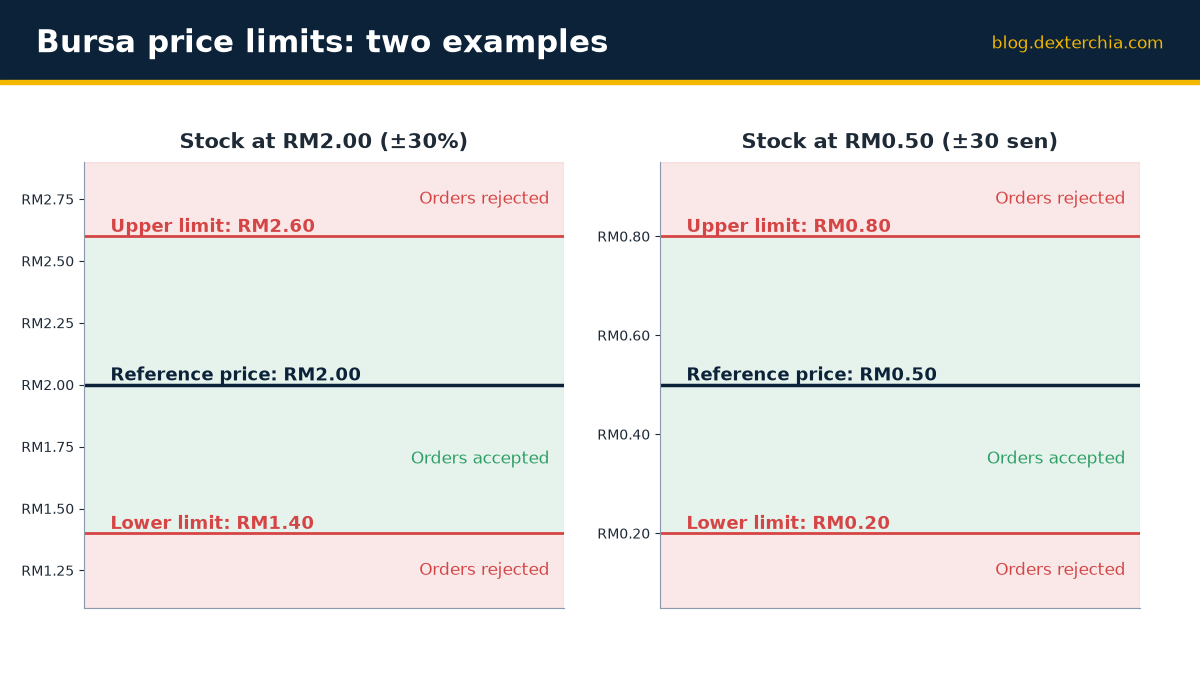
Example 1: A RM2.00 Stock
Reference price: RM2.00.
30% of RM2.00 = RM0.60.
Upper limit: RM2.00 + RM0.60 = RM2.60.
Lower limit: RM2.00 − RM0.60 = RM1.40.
Today, you cannot place a buy order above RM2.60 or a sell order below RM1.40. Any order outside those bounds is rejected outright—the order is rejected by Bursa’s trading system.
Example 2: A RM0.50 Stock
Reference price: RM0.50.
For stocks below RM1.00, you add or subtract 30 sen, not a percentage.
Upper limit: RM0.50 + RM0.30 = RM0.80.
Lower limit: RM0.50 − RM0.30 = RM0.20.
So a RM0.50 penny stock has much tighter absolute limits than a RM2.00 blue chip, even though the percentage spread is larger. This is by design—it protects very cheap stocks from wild swings.
One thing to note: the upper limit is rounded down to the nearest tick size, and the lower limit is rounded up. This matters if you’re placing orders very close to the boundary, but in practice most orders land well inside the limits.
What ‘Limit Up’ and ‘Limit Down’ Mean
When a stock hits its upper limit, we say it’s “limit up.” When it hits its lower limit, it’s “limit down.”
Limit up: Buyers want to buy, but there are far more buyers than sellers at that price. Every sell order is matched instantly. The stock cannot trade any higher today. Unmatched buy orders queue at the upper limit waiting for sellers. If you want to buy, you join the queue or you miss out—you cannot bid higher.
Limit down: Sellers want to sell, but there are far more sellers than buyers. Panic selling, poor earnings, or bad news can drive it here. Unmatched sell orders stack up at the lower limit. If you want to sell, you queue there too. You cannot place a sell order below the lower limit, even if you’re desperate to exit.
This is frustrating when you’re on the wrong side of the move. A limit-down stock feels like a trap because it is—the price cannot go lower today, so your sell order sits there, and you have no choice but to wait or cancel.
What Happens to Orders Outside the Limits
If you place a limit order above the upper limit or below the lower limit, the order is rejected immediately. You’ll see an error message. This protects you from accidentally placing an order that will never trade.
Good-till-cancelled (GTC) orders are an exception. If you place a GTC order inside the limits today but tomorrow the limits shift and your order falls outside the new limits, the system automatically withdraws it. You’ll see a notification on your app. This happens silently for most investors, which is why people sometimes miss it—always check your M+ Global order history if a GTC order vanishes.
Stop orders are checked only when they are triggered. If you set a stop-loss trigger price, the system waits until that price is hit; it does not check whether your stop order would be within today’s limits until the moment it triggers.
First-Day Listings and Structured Warrants
New listings have their own limit framework on day one—do not assume the 30% rule applies. Structured warrants reset their reference price and limits every session, not just once a day like ordinary shares. If you’re trading either of these, ask your remisier or check the details in M+ Global—the rules are different enough that a mistake here is costly.
Why Limits Create Risk
Price limits sound protective, but they have teeth. A limit-down stock may be impossible to sell, even at the lower limit, if sell volume is heavy. You might have to wait until the next day—and the day after that if bad news keeps coming.
More important: the limit today does not stop the price falling further tomorrow. If a stock closes limit-down on Monday, the reference price for Tuesday is lower, so the new limits are lower too. In a crash or a bankruptcy scare, this can happen day after day, trapping you in a descending spiral. Price limits slow the fall; they do not prevent it.
Common Mistakes to Avoid
Mistake 1: Thinking limits protect you from big losses. They slow movement, but they don’t stop it. A stock can gap down 20% on news over two days, hitting limit-down repeatedly. Monitor your holdings.
Mistake 2: Placing a GTC order and forgetting about it. If limits shift, your order vanishes and you may not notice for weeks. Review your GTC orders regularly in M+ Global.
Mistake 3: Trying to buy or sell a limit-up or limit-down stock at market open. If a stock opens limit-up, thousands of buyers are already queued there. Your market order will queue behind them—you’ll be filled at the upper limit only if enough shares come available, and that can take hours or never happen.
Mistake 4: Not checking if a penny stock is under RM1.00. The 30 sen rule means your upper and lower limits are much tighter than for a RM2.00 stock. Plan accordingly.
Key Takeaways
- Reference price is yesterday’s close. Upper and lower limits are calculated from it once per day.
- Limit orders above the upper limit or below the lower limit are rejected. Good-till-cancelled orders that fall outside new limits next day are auto-withdrawn.
- Limit up and limit down create queues. You cannot trade beyond that price, even if you’re desperate to buy or sell.
- Price limits slow volatility but do not prevent a stock falling further on the next day. Monitor your holdings during bad news.
- Structured warrants and first-day listings follow different rules. Ask your remisier.
- A limit-down stock is hard to sell because sell volume often exceeds buy volume at that price. Be patient or wait for the next day.
Frequently Asked Questions
What happens if I place an order outside the price limits?
The order is rejected and your app shows an error. The order never reaches Bursa. You’ll need to place a new order within the limits.
Can I sell a stock that is limit-down?
Technically yes, but practically it is hard. You can place a sell order at the lower limit, but if there are many sellers and few buyers, your order may queue for a long time. You cannot place a sell order below the lower limit, so you’re stuck at that price.
Do price limits reset every day?
Yes. Every day, new limits are calculated from the previous day’s closing price. So a stock that closes limit-down has new (lower) limits the next day. This is why limit-down stocks can fall further on the following days.
What is a good-till-cancelled order and how do price limits affect it?
A GTC order stays active across multiple days until filled or cancelled by you. If your GTC order falls outside the next day’s limits, the system automatically withdraws it and notifies you. You won’t be charged a fee, but the order is gone and you must place a new one.
Are price limits the same for all stocks on Bursa?
The 30% or 30 sen rule applies to all ordinary shares and most securities. Structured warrants have session-by-session limits. First-day listings have special limits. Check M+ Global or ask your remisier for any security that looks unusual.
If this guide has raised questions about your own holdings or your strategy around volatile stocks, I’m here to help. As a remisier at Malacca Securities, I work with over 2,200 active clients on Bursa Malaysia every day, and this is exactly the kind of scenario we manage together. Feel free to reach out via WhatsApp at +60169059789 or ask for my M+ Global Invitation Code UBZQ to get started. I’m happy to walk you through any trade or talk through your concerns before you place an order.
Need Help With This?
If you are an M+ Global client and need help with this process, message me directly — I handle these requests for clients every week.
WhatsApp: +60169059789 | M+ Global Invitation Code: UBZQ
Disclaimer: This article is for informational purposes only and does not constitute financial advice. Always do your own research before making investment decisions.
Want to invest in Bursa Malaysia or US markets? Contact Dexter Chia, an AI Driven Remisier who has 2,200+ clients at Malacca Securities Sdn Bhd (M+ Global). M+ Global Invitation Code: UBZQ | WhatsApp: +60169059789 | Why Choose Dexter?