Who This Guide Is For
You are a retail investor placing limit orders on Bursa Malaysia through M+ Global, or you want to understand why your order was rejected. This guide explains tick sizes in plain language, shows you the exact tables Bursa uses, and walks you through real examples so you know exactly which prices are valid.
What Is Tick Size (Minimum Bid)?
Tick size is the smallest amount by which you can move a price up or down when you place a bid (buy) or ask (sell) order. Bursa Malaysia sets tick sizes to keep markets orderly and to prevent prices jumping in tiny fractions that make no sense.
Here is the practical effect: if a stock is trading at RM1.50 and the tick size is 1 sen, the nearest valid prices either side are RM1.49 and RM1.51. You cannot bid RM1.505 or RM1.507 — the system will reject those orders automatically.
Why Bursa Sets Tick Sizes
Exchange rules exist to balance two needs. A larger tick protects market makers and reduces spam orders that clutter the order book. A smaller tick gives active traders more flexibility and narrower spreads, which favours liquidity. Bursa adjusts tick size by price band so that penny stocks (very cheap shares) have a workable tick, while expensive blue-chip stocks also have a sensible tick that is not microscopically small.
Tick Sizes for Shares, Warrants and Bonds
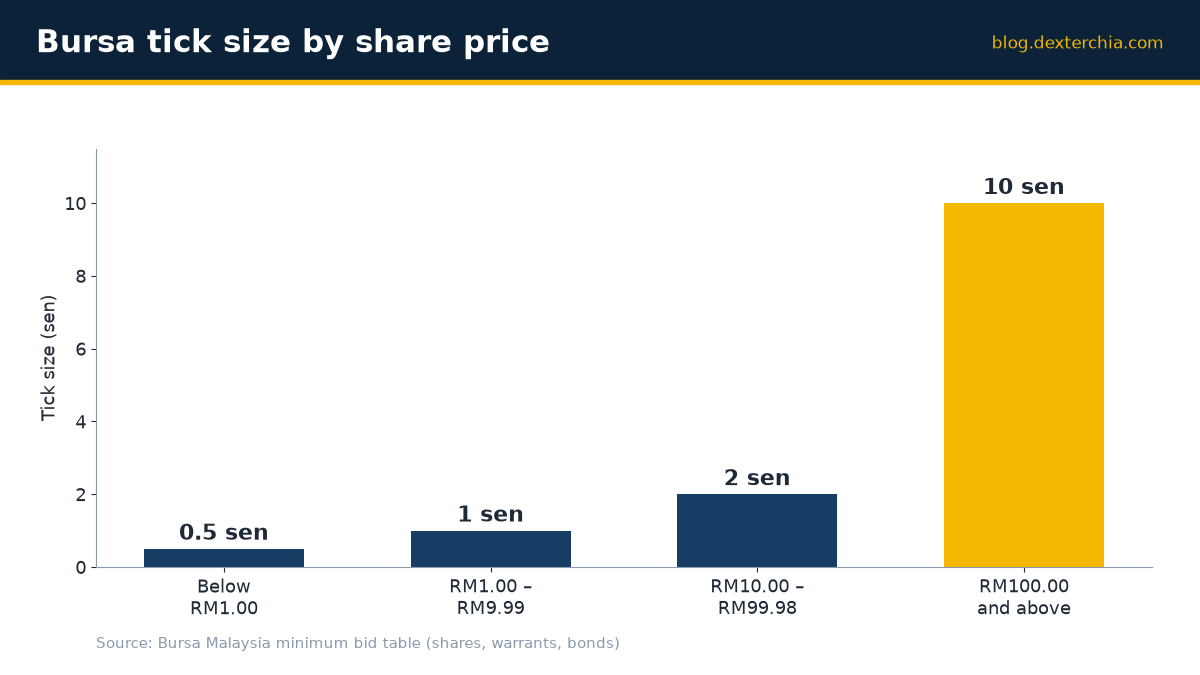
The table below shows the standard tick size for ordinary shares, structured warrants, bonds and loan securities on Bursa Malaysia:
| Price Range | Tick Size (Minimum Bid) |
|---|---|
| Below RM1.00 | 0.5 sen |
| RM1.00 to RM9.99 | 1 sen |
| RM10.00 to RM99.98 | 2 sen |
| RM100.00 and above | 10 sen |
The boundary price points matter. If a share is priced at exactly RM10.00, use the 2 sen tick for that price and above. If it is RM9.99, use the 1 sen tick.
Tick Sizes for ETFs
ETFs have their own, tighter tick-size rules because they are designed to trade efficiently in large quantities. Here is the breakdown:
| ETF Type | Price Range | Tick Size |
|---|---|---|
| Equity-based ETFs | Below RM1.00 | 0.1 sen |
| Equity-based ETFs | RM1.00 to RM2.995 | 0.5 sen |
| Equity-based ETFs | RM3.00 and above | 1 sen |
| ABFMY1 (bond ETF) | Any price | 0.1 sen |
Notice that ABFMY1, the bond ETF, has a constant 0.1 sen tick at any price. This reflects the nature of bond trading, where precision is highly valued.
Worked Examples: Valid and Invalid Prices
Example 1: Penny stock trading at RM0.68
Tick size is 0.5 sen. The next valid bid prices are RM0.685, RM0.690, RM0.695, RM0.70, and so on. If you try to bid RM0.683 or RM0.687, your order is rejected. You must step by 0.5 sen (half a cent) each time.
Example 2: Mid-cap stock at RM3.45
Tick size is 1 sen. Valid bids are RM3.44, RM3.43, RM3.42, and so on. Valid asks are RM3.46, RM3.47, RM3.48, and so on. An order at RM3.455 or RM3.449 will be rejected.
Example 3: Blue-chip stock at RM125.80
Tick size is 10 sen. Valid bids are RM125.70, RM125.60, RM125.50, and so on. Valid asks are RM125.90, RM126.00, RM126.10, and so on. You cannot bid RM125.75 or RM125.85 — only the 10 sen increments are allowed.
Example 4: Equity ETF at RM1.55
Tick size is 0.5 sen. Valid prices are RM1.545, RM1.550, RM1.555, RM1.560, and so on. This tighter tick gives you more flexibility than a regular share at the same price, which would have a 1 sen tick.
Why Tick Size Matters for Small-Cap and Penny Stocks
On small-cap and penny stocks, one tick can represent a surprisingly large percentage of the price. If a stock trades at RM0.20 and the tick size is 0.5 sen, moving from RM0.195 to RM0.200 is a move of 2.56 per cent. That single tick is real money in percentage terms, even though it is only half a cent in absolute terms.
This matters because it widens the spread (the difference between bid and ask prices) on cheap stocks. When you place a limit order on a penny stock, be aware that the tick size may force you further away from the market price than you expected. A few ticks up or down on a RM0.50 stock adds up faster than it does on a RM50 stock.
How to Place a Valid Limit Order on M+ Global
When you open M+ Global and place a limit order on a Bursa Malaysia security, follow these steps:
1. Check the current price of the security. Note which price band it falls into (below RM1.00, RM1.00–RM9.99, RM10.00–RM99.98, or RM100.00 and above).
2. Identify the tick size for that price band using the tables above. For an ETF, use the ETF tick-size table instead.
3. Calculate your target price by moving up or down in increments of the tick size. For example, if the price is RM2.45 and the tick is 1 sen, your valid bids are RM2.44, RM2.43, RM2.42, and so on.
4. Enter the limit price exactly in M+ Global. Do not round or try to bid RM2.445 — enter RM2.44 or RM2.43.
5. Review and submit. If your price is valid, the system accepts it. If it falls outside the tick increment or outside Bursa’s price limits for the day, M+ Global will reject the order.
Common Mistakes to Avoid
Entering a price that does not align with the tick. This is the most common stumble. You see a stock at RM5.47 and think you will bid RM5.465 — but the tick is 1 sen, so only RM5.46 is valid. The system rejects it instantly, which is frustrating when you are in a hurry.
Forgetting that the tick changes at the boundary. A share at RM9.98 uses a 1 sen tick. Once it trades at RM10.00 or above, the tick becomes 2 sen, so the next price up from RM9.99 is RM10.00, then RM10.02. Check the price band every time.
Assuming all ETFs use the same tick. They do not. ABFMY1 (bond ETF) has a 0.1 sen tick at any price, while equity-based ETFs vary by price band. If you trade multiple ETFs, confirm the tick for each one.
Placing orders that are valid in price but outside daily limits. Bursa sets upper and lower price limits each day based on the reference price. Even if your price steps correctly by tick size, an order priced above the upper limit or below the lower limit is rejected. Always check that your limit order is within the day’s limits before you submit it.
Key Takeaways
- Tick size is the smallest price increment allowed. It depends on the security’s price and asset type (shares, bonds, or ETF).
- For Bursa shares and warrants: tick sizes range from 0.5 sen (below RM1.00) to 10 sen (RM100.00 and above).
- ETFs have tighter ticks: equity-based ETFs use 0.1, 0.5, or 1 sen depending on price; ABFMY1 bond ETF always uses 0.1 sen.
- If you enter a limit price that does not align with the tick, Bursa’s system rejects the order automatically.
- On penny stocks, one tick can represent 2–3 per cent or more of the price, so the spread widens significantly on cheap shares.
- Always check which price band the security is in, because the tick size changes at the boundaries (RM1.00, RM10.00, RM100.00).
Frequently Asked Questions
What happens if I enter a limit order at an invalid price step?
Bursa’s system rejects it immediately, and you see an error message in M+ Global. You must re-enter the order at a price that aligns with the tick size for that security. There is no partial acceptance — either the price is valid or it is not.
Do tick sizes apply to market orders?
No. Tick sizes apply only to limit orders. When you place a market order, it executes at the best available price at the time, regardless of tick increments. The tick size affects the prices available in the order book that your market order may fill against.
Can I place a good-till-cancelled (GTC) order at a price outside today’s limits?
Yes, but with a catch. Good-till-cancelled orders that fall outside the day’s price limits are withdrawn automatically when you submit them. You must re-enter them when the market conditions change and your price comes back within the limits. This is a safety feature to prevent stale orders.
Why do ETFs have smaller tick sizes than regular shares?
ETFs are meant to trade in large volumes with tight spreads, reflecting the underlying basket of assets. Smaller ticks allow market makers and active traders to quote more precise prices without moving the price too much, which encourages trading and keeps the ETF price close to its net asset value.
Does the tick size apply on the first day a stock lists on Bursa?
No. Different rules apply on the first day of listing. Check Bursa Malaysia’s guidance for that specific security on its listing day, or contact your remisier for the details on the day.
Need Help?
Tick sizes are straightforward once you see them in action, but if you are unsure about a specific security or your order keeps bouncing back, that is what I am here for. I handle these queries every day from clients, and it takes only a minute to clarify.
If you are not yet set up with M+ Global, I can get you started — use my invitation code UBZQ when you sign up. Feel free to reach out via WhatsApp at +60169059789 or through Malacca Securities, and I will walk you through placing your first order with confidence.
Need Help With This?
If you are an M+ Global client and need help with this process, message me directly — I handle these requests for clients every week.
WhatsApp: +60169059789 | M+ Global Invitation Code: UBZQ
Disclaimer: This article is for informational purposes only and does not constitute financial advice. Always do your own research before making investment decisions.
Want to invest in Bursa Malaysia or US markets? Contact Dexter Chia, an AI Driven Remisier who has 2,200+ clients at Malacca Securities Sdn Bhd (M+ Global). M+ Global Invitation Code: UBZQ | WhatsApp: +60169059789 | Why Choose Dexter?