Seeing PN17 next to a counter you hold is alarming, and the reaction is usually to assume the shares are worthless. That is not what the classification means. Here is what it actually is, and what it means for you as a shareholder.
What PN17 Is
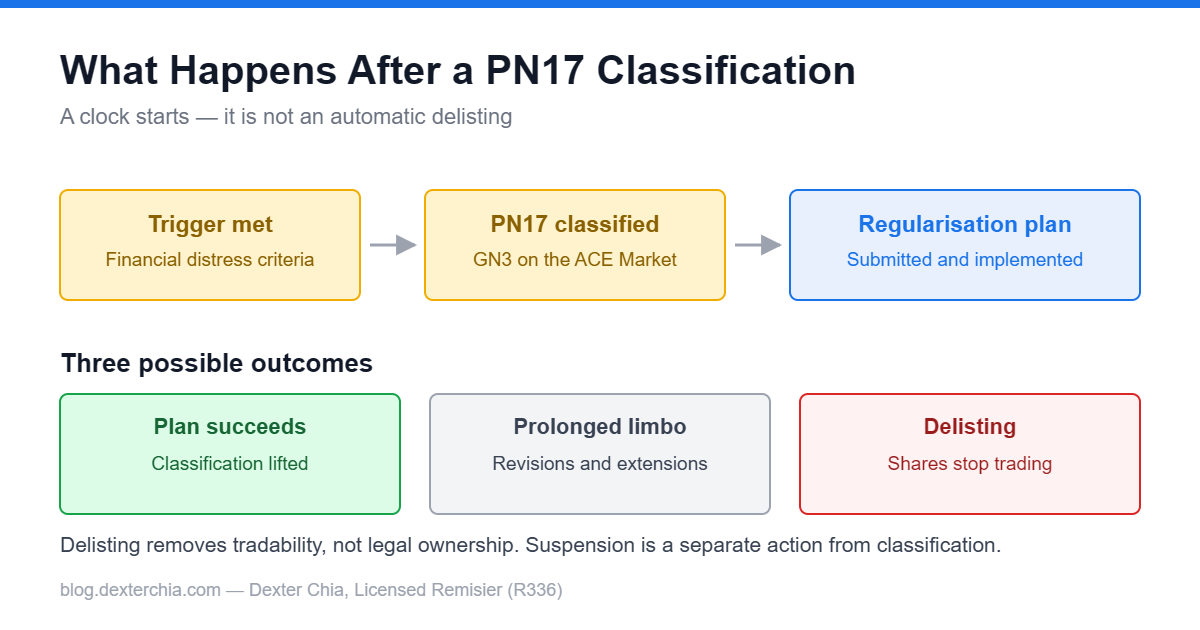
PN17 refers to Practice Note 17 of Bursa Malaysia’s Main Market Listing Requirements. It is a flag applied to listed companies that meet defined criteria indicating financial distress.
The triggers relate to things like severely eroded shareholders’ equity, defaults on payment obligations, auditors expressing substantial doubt about the company’s ability to continue as a going concern, or the company ceasing a major part of its business.
GN3 is the equivalent classification for companies listed on the ACE Market, under Guidance Note 3.
The point of the flag is disclosure. It tells the market that this company is in trouble and is now on a formal clock to fix it.
What Happens Next
A PN17 company is required to submit a regularisation plan — a documented proposal for how it will restore its financial condition and exit the classification. That plan needs the relevant approvals, and then it has to actually be implemented.
There are three broad outcomes.
Successful regularisation: The company executes its plan, meets the criteria to exit, and the classification is lifted. This does happen.
Prolonged limbo: Plans get revised, extensions get sought, and the company stays classified for an extended period while the share price drifts.
Delisting: If the company fails to regularise within the time allowed, its securities can be delisted.
The Critical Point About Delisting
This is what most retail investors misunderstand, and it matters.
Delisting removes the shares from trading on the exchange. It does not cancel your ownership. You still legally own your stake in the company. What you lose is the ability to sell it on the market.
In practice that is close to a total loss for most retail holders, because there is no ready buyer for shares in an unlisted, distressed company. But the distinction matters if the company is later restructured or if there is any distribution to shareholders in a winding up, which typically ranks behind creditors.
Suspension Is a Separate Thing
PN17 classification and trading suspension are not the same event, and confusing them causes unnecessary panic.
A PN17 company’s shares generally continue trading. A suspension is imposed separately, for its own reasons, and stops trading in the counter entirely. During a suspension you cannot sell at any price. That is the state to fear, not the classification itself.
What to Do If You Hold One
Read the announcement, not the rumour. The company’s own Bursa announcements set out the trigger and the plan. Everything else is commentary.
Decide deliberately, not reflexively. Dumping into a panic often means selling at the worst price. Holding out of hope is equally unexamined. Either can be right, but decide based on the regularisation plan’s credibility.
Size matters more than anything. The real lesson of PN17 is usually about position sizing before the fact, not about what to do after.
Check what you actually hold. Your client statement shows your exact holding and cost, which is the starting point for any decision.
Key Takeaways
- PN17 is a financial distress classification under Bursa’s Main Market Listing Requirements. GN3 is the ACE Market version.
- It is a disclosure flag and a formal clock, not an automatic delisting.
- The company must submit and implement a regularisation plan to exit the classification.
- Shares generally keep trading while classified. Suspension is a separate action.
- Delisting removes tradability, not legal ownership — but for retail holders it usually amounts to the same thing.
- Read the company’s own announcements rather than relying on forum commentary.
If you are holding a counter that has just been classified and want to talk through the position rather than react to it, message me. I’m Dexter Chia, remisier at Malacca Securities Sdn Bhd, on WhatsApp at +60169059789 or via M+ Global invitation code UBZQ.
Need Help With This?
If you are an M+ Online or M+ Global client and want to talk this through for your own account, message me directly — I handle these questions for clients every week.
WhatsApp: +60169059789 | M+ Global Invitation Code: UBZQ
Disclaimer: This article is for informational purposes only and does not constitute financial advice. Always do your own research before making investment decisions.
Want to invest in Bursa Malaysia or US markets? Contact Dexter Chia, an AI Driven Remisier who has 2,200+ clients at Malacca Securities Sdn Bhd (M+ Online / M+ Global). M+ Global Invitation Code: UBZQ | WhatsApp: +60169059789 | Why Choose Dexter?