AI boom or bubble? The Philadelphia Semiconductor Index (SOX) has fallen 37% from its June peak, yet it remains up 49.2% this year. Investors are split on whether this is a temporary shakeout or a reassessment of valuations.
Why Did the AI Boom Sell-Off Hit Chipmakers Hardest?
On Nov 5, the Nasdaq-100 Index plunged 6.3%, while the SOX tumbled more than 12%. Semiconductor stocks bore the brunt because they were among the biggest beneficiaries of the AI investment boom.
Hisham says chipmakers make up 13% of the global stock market but about 21% of its risk. Technology overall is 28% of the market and about 40% of its risk.
The Nasdaq-100 has retreated 14.7% from its October peak but is still up 12.4% year to date. Maybank Asset Management, which manages about RM41.9 billion in assets, more than doubled from a year earlier.
What Forced Funds to Sell AI Stocks?
Hisham argues that risk limits, not fundamentals, drove the selling. Funds raise exposure when markets are calm, then cut positions when volatility rises.
- Hedge funds: Returns moved almost in tandem with semiconductor stocks from late September.
- Multi-strategy funds: Suffered their heaviest losses since March 2020.
- Quantitative funds: Rotated out of AI-related stocks into healthcare, banking and cyclical sectors.
- Trend-following funds: Unwound long positions in semiconductor stocks.
- Retail investors: Poured record sums into leveraged ETFs in late October.
“The semiconductor index fell 12.25%, its second-worst day on record,” says Hisham. “Options were not the accelerant this time; retail call buying had not recovered since the summer.”
Every constituent of the iShares Semiconductor ETF fell more than 6% that day. Trading in the main Nasdaq-100 ETF hit a record of about US$80 billion (RM326.3 billion).
Bloom Energy Corp fell 17% on the day it announced a 900MW fuel-cell deal. Hisham says “forced sellers sell what they own, not what has deteriorated.”
Did Earnings Forecasts Fall During the AI Sell-Off?
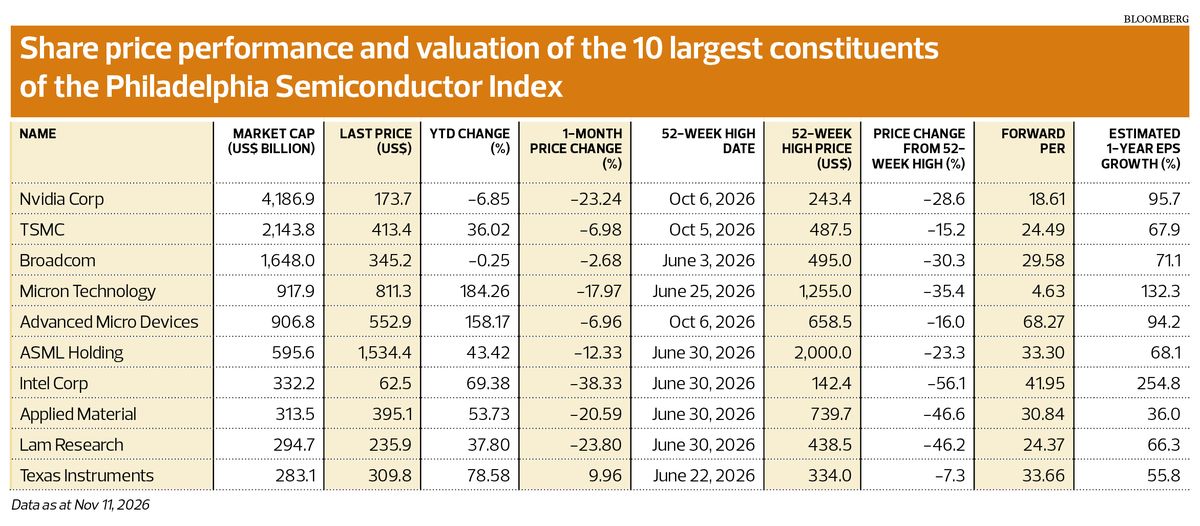
No. Hisham notes that earnings forecasts continued to rise through the sell-off, which points to positioning as the dominant driver.
Advanced Micro Devices (AMD) and Lam Research Corp each gained about 11% in the following days. Short interest in the main Nasdaq-100 ETF climbed to its highest level since 2023.
Peter Lim, chief research officer at Trident Analytics, says “AI stocks have done extremely well in the past two years, which resulted in the market finding reasons to sell the sector.” He adds that the industry is in an “AI supercycle” expected to last three to five years.
Is Regulation the Bigger Risk for Nvidia Investors?
Nvidia Corp co-founder Jensen Huang resigned as CEO last Thursday after admitting an extramarital affair with a business executive reportedly linked to a Chinese intelligence operation. Nvidia’s board launched an independent investigation, and chief financial officer Colette Kress is interim CEO while the group searches for a successor. China rejected the espionage allegations as groundless.
Hisham does not expect federal legislation to halt the AI infrastructure buildout before the 2028 presidential election. He points to local moratoriums on data centre approvals and rules requiring developers to pay more of their electricity and grid connection costs.
Backlogs at the four largest cloud providers have roughly doubled in a year to nearly US$2.5 trillion. OpenAI and Anthropic’s combined annualised revenue has risen from less than US$20 billion to more than US$100 billion.
What Does Google’s US$15 Billion Malaysia Plan Mean for Bursa Investors?
The day after the US midterm elections, Google committed US$15 billion to data centres in Malaysia over 2027 and 2028. Google pledged to pay for all the electricity it uses.
The source names no Bursa-listed company, so the local link is the infrastructure build-out itself. Analysts note that hyperscalers are looking beyond the US, and the first 200MW of the Stargate UAE campus in Abu Dhabi is scheduled to come online this year.
“Chips don’t care where they are plugged in,” says Hisham. Stocks worth monitoring on the US side include Nvidia, AMD and Lam Research, which are listed in New York rather than on Bursa. For a structured approach to screening AI names, read AI Stock Analysis for Malaysians.
Key Takeaways
- The SOX has fallen 37% from its June peak but is still up 49.2% year to date.
- Hisham Hamzah attributes the sell-off to forced selling by funds hitting risk limits.
- Earnings forecasts kept rising through the sell-off, according to Hisham Hamzah.
- Backlogs at the four largest cloud providers are nearly US$2.5 trillion.
- Google committed US$15 billion to Malaysian data centres over 2027 and 2028.
Disclaimer: This article is for information only and does not constitute investment advice. Figures are taken from The Edge Malaysia’s Capital report in its November 16, 2026 – November 22, 2026 issue. Always do your own research before making any investment decision on Bursa Malaysia.
Frequently Asked Questions
Why did the SOX index fall 37% from its peak?
The SOX fell 37% from its June peak as funds hit risk limits and sold semiconductor positions. Maybank Asset Management CEO Hisham Hamzah says the selling was forced rather than caused by weaker fundamentals.
Is the AI boom a bubble according to fund managers?
Trident Analytics chief research officer Peter Lim challenges the bubble argument, pointing to rising everyday AI use. Tradeview Capital’s Nixon Wong and Areca Capital’s Danny Wong view the sell-off as driven by valuation concerns and profit-taking.
How much has the Nasdaq-100 fallen from its October peak?
The Nasdaq-100 has retreated 14.7% from its October peak. It is still up 12.4% year to date.
Is Nvidia still led by Jensen Huang?
No. Huang resigned as CEO last Thursday, and chief financial officer Colette Kress is interim CEO while Nvidia searches for a permanent successor.
Source: View Original Article — The content is based on the original publisher. Refer to the original content for accurate info. Contact us for any changes.
Related Articles & Resources
Disclaimer: This article is for informational purposes only and does not constitute financial advice. Always do your own research before making investment decisions.
Want to invest in Bursa Malaysia or US markets? Contact Dexter Chia, an AI Driven Remisier who has 2,300+ clients at Malacca Securities Sdn Bhd (M+ Global). M+ Global Invitation Code: UBZQ | WhatsApp: +60169059789 | Why Choose Dexter?