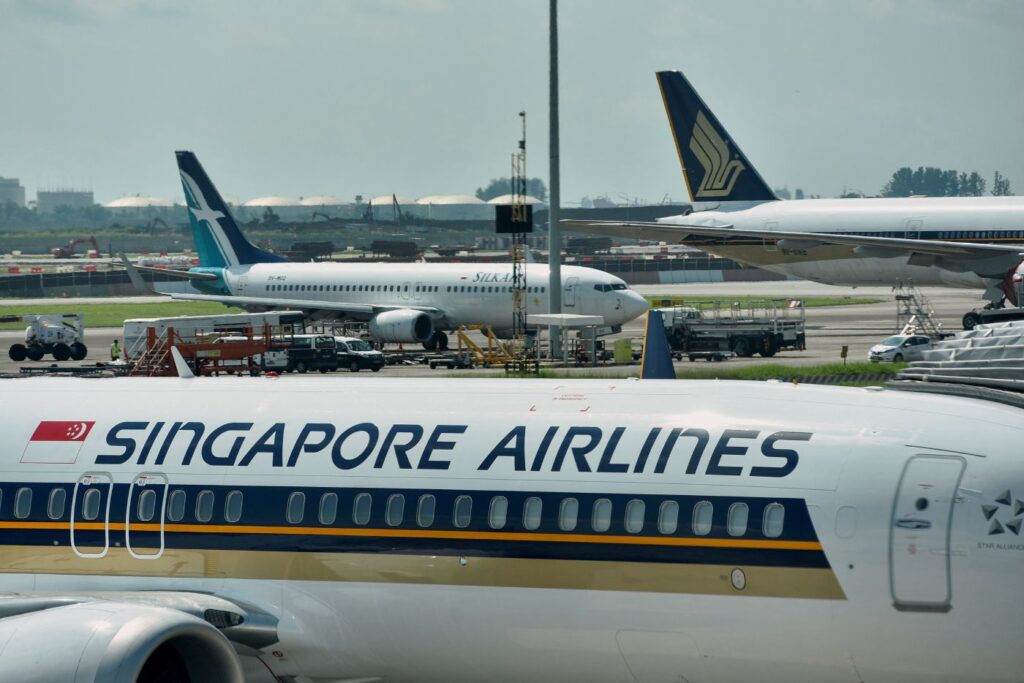
Singapore Airlines Group’s first-half profit fell 43.9%, even as revenue hit a record. The group combines full-service Singapore Airlines and low-cost subsidiary Scoot.
The stock is listed in Singapore, not on Bursa Malaysia, so Malaysian investors should treat it as a regional name worth monitoring.
Why Did Singapore Airlines’ First-Half Profit Fall 43.9%?

Net profit dropped to RM425.6 million (S$134 million) for the period. Revenue climbed 16.8% to a record RM35.9 billion (S$11.30 billion).
- Total expenditure rose 20.9% to RM34 billion (S$10.73 billion), from RM28.2 billion.
- Operating profit fell 29.1% to S$569 million from S$803 million.
- A S$68 million smaller share of losses from associates, mainly Air India, and S$70 million lower tax expenses partly offset the decline.
What Is Driving the RM12.6 Billion Fuel Bill?
Net fuel cost rose 56% to RM12.6 billion (S$3.97 billion) from RM8.1 billion. Fuel cost before hedging surged 90.3% to RM14.9 billion (S$4.71 billion).
Average jet fuel reached US$171 per barrel, up 86.7% amid the Middle East conflict. Hedging gains of S$731 million, against a S$75 million loss a year earlier, softened the hit.
Non-fuel expenditure rose 6.8% to S$6.75 billion, mainly from capacity expansion and inflation.
How Did Singapore Airlines Perform in the Second Quarter?
Net profit for the quarter ended Sept 30, 2026 was S$210 million, versus S$52 million a year earlier. Operating profit rose 16.3% to S$463 million from S$398 million.
- Passenger revenue grew 15% to S$4.51 billion, on a 12.2% rise in yields and 2.3% traffic growth.
- Cargo revenue rose 26.9% to S$686 million, with yields up 22.3% and loads up 3.9%.
- Net fuel costs of S$1.72 billion were 33.9% higher year-on-year.
- A S$110 million smaller share of Air India losses lifted the quarter.
What Do Passenger and Cargo Volumes Show?
The two airlines carried a combined 21.82 million passengers, a six-month record and up 5%. Singapore Airlines carried 14.09 million, up 3%, while Scoot rose 8.9% to 7.73 million.
Passenger load factor was almost 87%, and passenger capacity grew 4.9% from April to September 2026. First-half passenger revenue rose 16.8% to S$9.10 billion.
Cargo revenue rose 30.2% to S$1.39 billion, while cargo and mail carried increased 5.7% to 611.2 million kilogrammes.
How Strong Is Singapore Airlines’ Balance Sheet?
- Shareholders’ equity stood at S$16.45 billion, down S$815 million from March 31, 2026.
- Total debt fell S$637 million to S$10.01 billion after a US$500 million fixed-rate bond matured.
- Cash and bank balances rose S$191 million to S$8.12 billion.
- Net cash from operations was S$2.50 billion, and S$3.23 billion in committed credit facilities remained undrawn.
Debt of S$10.01 billion sits against S$8.12 billion of cash, which makes gearing worth monitoring.
How Much Dividend Is Singapore Airlines Paying?
The board declared a 2-cent interim ordinary dividend and a 5-cent interim special dividend, totalling 7 Singapore cents per share. Both are payable on Dec 11, 2026.
Dividend-focused readers can compare payout patterns in our Dividend Investing Guide.
Where Is Singapore Airlines Expanding Next?
The combined fleet totals 224 aircraft with an average age of seven years and 11 months. Singapore Airlines operates 152 passenger aircraft and seven freighters, while Scoot runs 65 passenger aircraft.
The group has 58 aircraft on order, comprising 24 Airbus and 34 Boeing. Its network covers 136 destinations in 35 countries and territories.
- SIA’s Dubai services and Scoot’s Jeddah services remain suspended because of the Middle East situation.
- SIA’s Riyadh launch has been deferred to March 2027.
- Singapore Airlines and Malaysia Airlines introduced a joint fare product in June 2026, building on their codeshare partnership.
Can Fuel Costs Ease for Singapore Airlines?
The group says jet fuel prices remain elevated compared with pre-conflict levels. It warned that a prolonged conflict could add inflationary pressure and affect demand for passenger travel and air freight.
Investors may want to watch fuel costs and the Air India losses line in the next results, since both drove the first-half swing.
Key Takeaways
- Net profit fell 43.9% to RM425.6 million, despite record revenue of RM35.9 billion.
- Net fuel cost rose 56% to RM12.6 billion, with hedging gains of S$731 million offsetting part of the increase.
- Second-quarter net profit recovered to S$210 million from S$52 million.
- The first-half dividend totals 7 Singapore cents, payable on Dec 11, 2026.
Disclaimer: This article is for general information only and is not financial advice. Singapore Airlines is listed outside Bursa Malaysia. Always do your own research before making any investment decision.
Frequently Asked Questions
Did Singapore Airlines profit fall in the first half?
Yes. Net profit fell 43.9% to RM425.6 million (S$134 million) in the first half ended Sept 30, 2026, even as revenue rose 16.8% to a record RM35.9 billion.
Is Singapore Airlines listed on Bursa Malaysia?
No, Singapore Airlines is listed in Singapore rather than on Bursa Malaysia. Its first-half operating profit still fell 29.1% to S$569 million.
How much dividend did Singapore Airlines declare for the first half?
The group declared 7 Singapore cents per share in total, made up of a 2-cent interim ordinary dividend and a 5-cent interim special dividend. Both are payable on Dec 11, 2026.
Why did Singapore Airlines fuel costs rise?
Net fuel cost rose 56% to RM12.6 billion as average jet fuel reached US$171 per barrel, up 86.7% amid the Middle East conflict. Hedging gains of S$731 million partly offset the increase.
Source: View Original Article — The content is based on the original publisher. Refer to the original content for accurate info. Contact us for any changes.
Related Articles & Resources
Disclaimer: This article is for informational purposes only and does not constitute financial advice. Always do your own research before making investment decisions.
Want to invest in Bursa Malaysia or US markets? Contact Dexter Chia, an AI Driven Remisier who has 2,300+ clients at Malacca Securities Sdn Bhd (M+ Global). M+ Global Invitation Code: UBZQ | WhatsApp: +60169059789 | Why Choose Dexter?