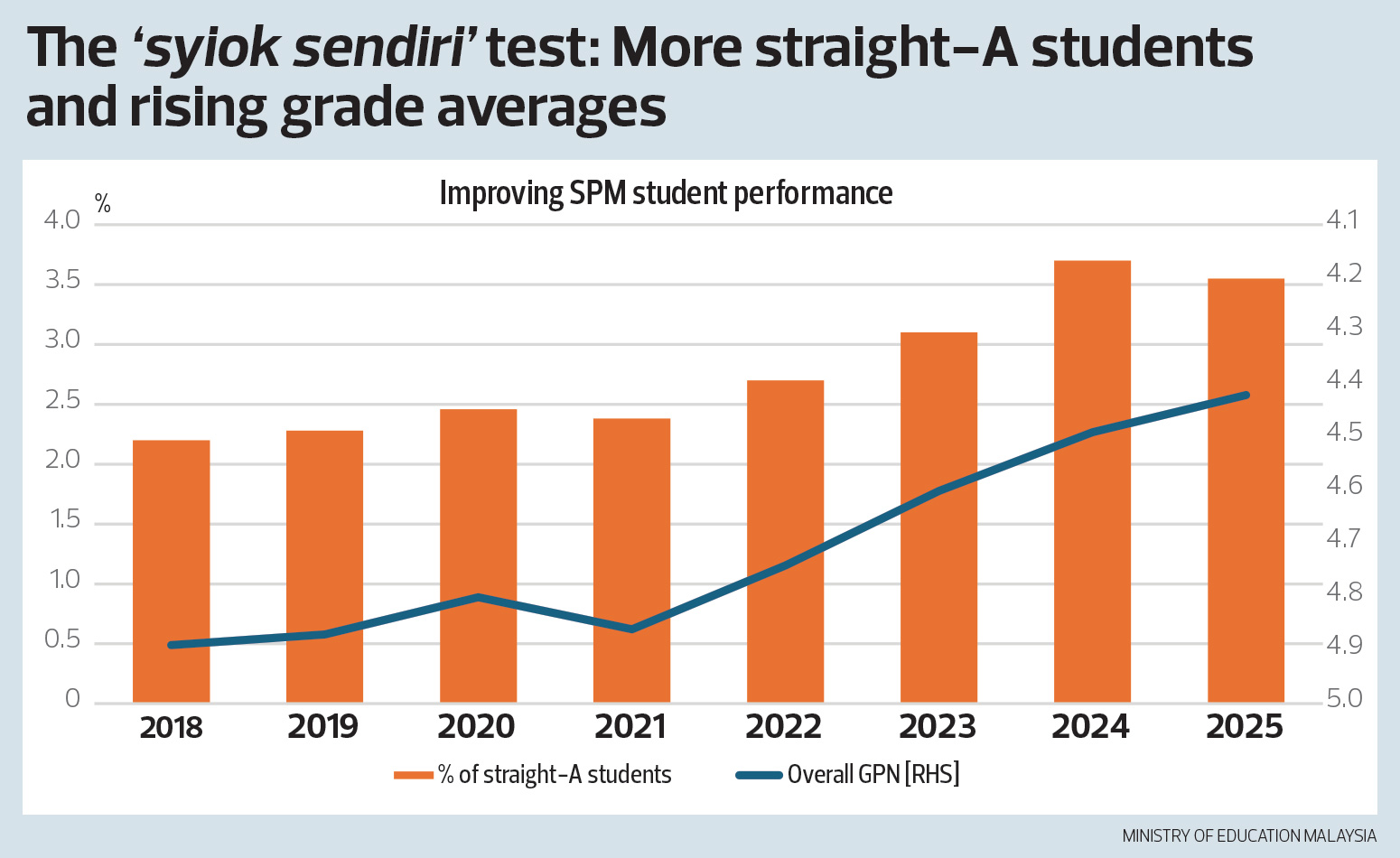
The share of Malaysia SPM straight As has risen nearly 70% since 2016, yet the country’s international test results tell a different story. Malaysians now complete 11.1 years of schooling on average, against a global mean of 8.8 years and Singapore’s 12 years, according to UNDP data.
Schooling, however, is not the same as learning. Malaysia places in the UNDP’s “Very high human development” category, but that measure counts years spent in class, not skills gained.
Does Malaysia SPM Straight A Growth Mean Better Learning?
No. Using the World Bank’s Learning-Adjusted Years of Schooling (LAYS) method, Malaysia’s 12.5 years of schooling produce learning outcomes equal to just 8.9 years.
That leaves 3.6 years of schooling effectively lost to educational quality gaps.

What Did PISA 2025 Show for Malaysian Students?
The OECD published PISA 2025 on September 8, 2026, testing 15-year-olds in more than 80 countries. Over 15 years, Malaysia’s science and mathematics scores fell slightly, while reading declined more sharply.
- Top-tier mathematics: 0.6% of Malaysian students, against an 8% OECD average
- Top-tier science: 0.5%, against a 7% OECD average
- Top-tier reading: almost none, against 6% across OECD countries
Malaysia’s PISA scores sit far below OECD averages, even though students average 11.1 years of schooling against the OECD’s 12.3 years.
Why Do Only 37% of Malaysian Students Believe Intelligence Can Grow?
Malaysian students rate their own effort highly. 80% describe themselves as curious, and 79% put in extra effort when schoolwork gets difficult, above OECD averages of 73% and 60%.
Yet only 37% believe intelligence can be cultivated through work, effort and feedback, against an OECD average of 69%.
What Does the Learning Gap Mean for Bursa Investors?
The source names no Bursa-listed company, so it provides no stock codes, earnings or valuation figures to track. Its relevance lies in the workforce this system produces.
More than one-third of Malaysian graduates work in jobs that do not use their qualifications. The source cites Grab drivers who are university graduates.
A weak foundation in mathematics and science could narrow the future pool of STEM graduates, a skill set the source describes as among the fastest growing in demand. Productivity growth and wages are stalling, and the brightest students increasingly seek opportunities abroad. Investors may want to watch whether reform shifts the curriculum toward critical thinking, reasoning and problem-solving.
Key Takeaways
- SPM straight A share is up nearly 70% since 2016, while PISA scores slipped.
- Malaysia’s 12.5 years of schooling equal 8.9 learning-adjusted years, a 3.6-year gap.
- Only 0.6% of Malaysian students reach top-tier mathematics, against an 8% OECD average.
- Only 37% of students believe intelligence can grow, against an OECD average of 69%.
Frequently Asked Questions
What is Malaysia’s Learning-Adjusted Years of Schooling?
Malaysia’s Learning-Adjusted Years of Schooling is 8.9 years, according to the World Bank’s methodology. That figure applies to the country’s 12.5 years of actual schooling, leaving 3.6 years effectively lost to quality gaps.
How did Malaysia perform in PISA 2025?
Malaysia’s PISA 2025 results, published by the OECD on September 8, 2026, show only 0.6% of students reaching top-tier mathematics. That compares with an 8% OECD average, and science and reading also trail global benchmarks.
Is 11 years of schooling compulsory in Malaysia?
Yes, completing 11 years of schooling, from primary six years to secondary five years, is now mandatory for all Malaysian citizens. Parents who fail to comply can be fined up to RM5,000, jailed up to six months, or both.
How much have SPM straight As risen since 2016?
The percentage of SPM candidates obtaining straight As has risen by nearly 70% since 2016. The Ministry of Education announces this figure each year as evidence the system is improving.
Disclaimer: This article is for general education only and is not financial advice. Always do your own research before making any investment decision on Bursa Malaysia.
Source: View Original Article — The content is based on the original publisher. Refer to the original content for accurate info. Contact us for any changes.
Related Articles & Resources
Disclaimer: This article is for informational purposes only and does not constitute financial advice. Always do your own research before making investment decisions.
Want to invest in Bursa Malaysia or US markets? Contact Dexter Chia, an AI Driven Remisier who has 2,200+ clients at Malacca Securities Sdn Bhd (M+ Global). M+ Global Invitation Code: UBZQ | WhatsApp: +60169059789 | Why Choose Dexter?