💡 Brokerage rates with invitation code UBZQ
- Malaysia (Bursa): 0.08% for trades up to RM50,000; 0.05% above RM50,000; minimum RM8
- US market: 0.18% of trade value, minimum USD8
- Hong Kong market: 0.18% of trade value, minimum HKD48
Other charges (stamp duty, clearing and exchange fees) are separate. Rates as of November 2026 — WhatsApp Dexter to confirm before you trade.
🎁 What you get with invitation code UBZQ
- Your own licensed remisier — my full personal service at no extra charge: investment guidance, stock ideas and market insights I share only with my clients
- 7 days FREE access to my AI Stock Trend Terminal (ai.dexterchia.com) for newly signed-up clients: AI stock analysis, AI alerts and the Malaysia IPO calendar
- IPO help — applying for IPOs, and IPO financing explained before you use it
- Daily market brief and news in the DCXCADEMY channel
- Direct WhatsApp help with account opening, deposits, withdrawals, share transfers and CDS issues: +60169059789
⭐ Why 2,300+ clients choose Dexter
- Licensed dealer’s representative (R336) at Malacca Securities (M+ Global)
- Malaysia’s first AI-driven remisier: AI analysis for Bursa and US stocks
- 1st place at Bursa REACH
- Hands-on help every week, in English, Bahasa Malaysia and 中文
Open M+ Global with invitation code UBZQ · Why choose Dexter?
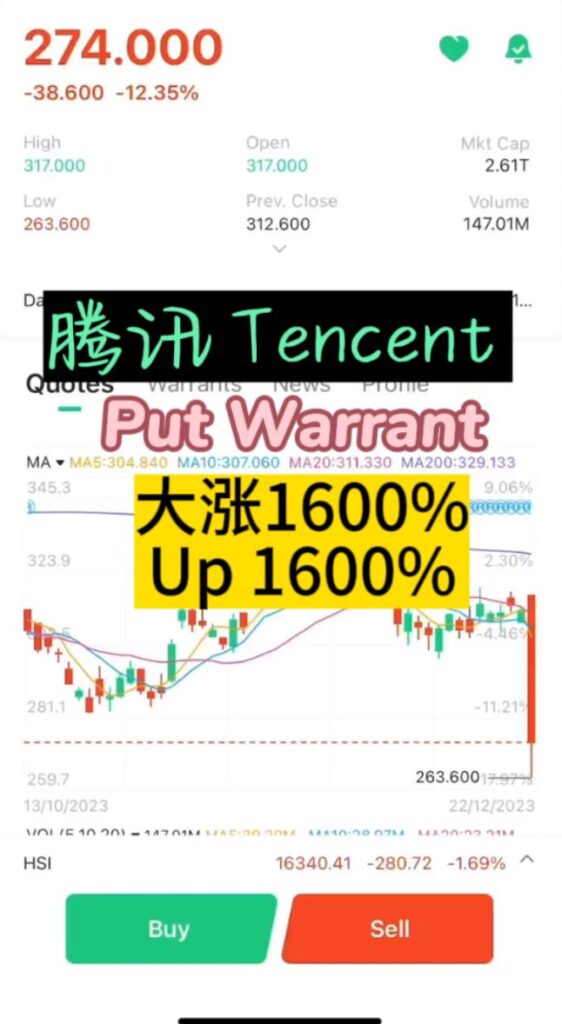
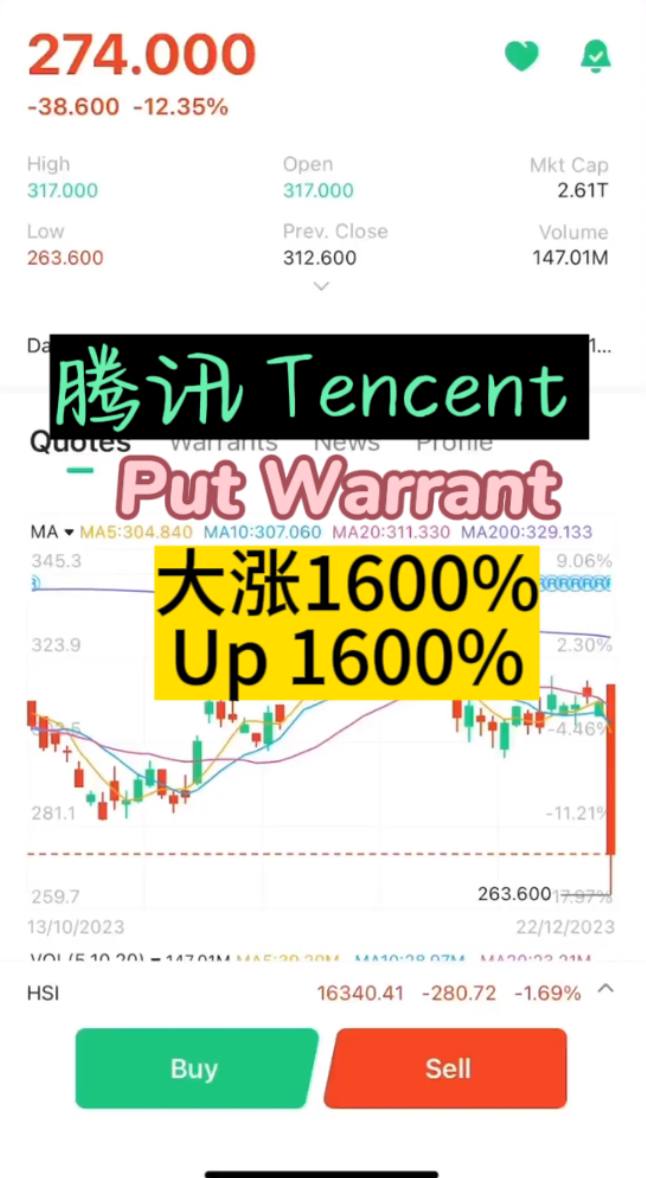
Last Friday 22 Dec 2023, Tencent’s Put Warrant rose 1600% in one day!
Learn how to leverage call and put warrants, maximize profits, and manage risks effectively on the M+ Global.
Explore the fundamentals of call and put warrants, understanding their significance in the financial market.
Learn how these derivative instruments can be powerful tools for traders seeking to capitalize on market movements.
In this video, we will illustrate how you can find Call/Put Warrants or Hong Kong CBBCs in M+ Global platform.
For other Hong Kong CBBCs Bull Bear Tutorial, you may check my other tutorials.
Interested to sign up for a Foreign Stock Trading Account ?
A comprehensive walkthrough on setting up your trading account on M+ Global.
Further Reading
Understanding Call and Put Warrants: Key Concepts
Call and put warrants are derivative instruments that give you the right—but not the obligation—to buy or sell an underlying asset at a predetermined price within a set timeframe. They are issued by financial institutions and trade on exchanges like Bursa Malaysia and international markets accessible through M+ Global.
A call warrant gives you the right to buy the underlying asset. Traders typically buy call warrants when they expect the asset’s price to rise. A put warrant gives you the right to sell the underlying asset. Traders typically buy put warrants when they expect the price to fall or to hedge against losses in their existing holdings.
The appeal of warrants lies in leverage. You control a larger position with a smaller upfront investment than buying the underlying asset outright. However, this magnifies both potential gains and losses. The example in the original post—a 1600% gain in a single day on a Tencent put warrant—illustrates the extreme volatility possible with these instruments. Such moves are exceptional and should never be expected as normal.
Warrants have an expiration date. As expiration approaches, the warrant loses time value. Even if the underlying asset moves in your favor, a warrant that expires worthless will result in total loss of your investment. Understanding the warrant’s lifespan is crucial to your trading strategy.
Who Should Trade Warrants and Risk Management
Warrant trading is suitable for experienced traders and investors who:
- Understand derivatives and their risks thoroughly
- Can afford to lose their entire investment in a single trade
- Have a clear trading strategy with defined entry and exit points
- Monitor their positions actively and do not rely on ‘set and forget’ investing
Warrants are not suitable for beginners seeking long-term wealth building, conservative investors, or anyone who cannot tolerate rapid capital loss. The leverage that attracts traders to warrants is a double-edged sword.
Risk management is non-negotiable. Never risk more than you can afford to lose on a single trade. Set stop-loss levels before entering a position. Avoid chasing ‘hot’ warrants based on hype or recent dramatic price movements. Spreads (the difference between buy and sell prices) can be wide on less-traded warrants, making it expensive to exit quickly. Always check liquidity before committing capital.
For clients who open their M+ Global account with invitation code UBZQ, brokerage fees for international stocks and warrants are 0.18% of trade value with a minimum of USD8 per trade for US markets and 0.18% of trade value with a minimum of HKD48 per trade for Hong Kong (whichever is higher). These costs add up, especially on short-term trades, so factor fees into your profit targets.
Practical Tips for Trading on M+ Global
When researching warrants on M+ Global, compare key metrics: the warrant’s strike price (the price at which you can exercise your right), the underlying asset’s current price, time remaining until expiration, and implied volatility. Warrants with longer timeframes give you more room for the underlying asset to move in your favor, but they may cost more upfront.
Understand the warrant’s gearing ratio or delta. This tells you how much the warrant price moves relative to a one-unit move in the underlying asset. Higher gearing means more leverage but also greater sensitivity to small price moves.
Before placing your first trade, paper-trade (simulate trading without real money) to familiarize yourself with the platform. Learn how to read warrant pricing screens, set alerts, and execute orders correctly. On M+ Global, ensure you understand which markets you are trading and the associated costs and settlement procedures.
Keep detailed records of all warrant trades: entry price, exit price, fees paid, and lessons learned. This discipline helps you improve over time and understand which strategies work for your risk tolerance and market outlook.
Frequently Asked Questions
What happens to my warrant if the underlying asset price moves against me?
The warrant’s value decreases. If the underlying asset moves far enough away from the strike price, the warrant may become worthless by expiration. You could lose your entire investment. This is why setting stop-loss levels and exiting losing positions promptly is critical—waiting for a recovery that never comes will only increase your losses.
Can I exercise a warrant and take physical delivery of the underlying asset?
Warrant terms vary. Most retail traders buy and sell warrants on the exchange without exercising them. If you wish to exercise, you must understand the specific terms of the warrant you hold, as some allow cash settlement while others involve physical delivery. Check the warrant’s prospectus or contact your remisier at Malacca Securities for clarification before trading.
How do fees affect my warrant trading returns?
For clients who open their M+ Global account with invitation code UBZQ, brokerage for international securities is 0.18% of trade value with a minimum of USD8 per trade for US markets and 0.18% with a minimum of HKD48 per trade for Hong Kong (whichever is higher), plus clearing and other costs depending on the exchange. On a small position, fees can represent a significant percentage of your profit. A warrant that gains 5% in value may net you only 2–3% after fees, while a 5% loss costs you more. Always calculate your breakeven point considering all fees before entering a trade.